
From absenteeism and turnover to disability claims and engagement scores, every organization tracks people metrics. When viewed together, these metrics help to spotlight how people show up at work, and they tell an important part of the workplace wellbeing story.
The challenge with these metrics, though, is they often tell you what’s already happened. Rarely do they explain why it’s happening or what leaders should do next.
As workplace dynamics continue to evolve alongside economic uncertainty, new ways of working and rapid technological change, organizations need a clearer view of the factors shaping employee wellbeing.
This is where the TELUS Mental Health Index (MHI) comes in.
The MHI goes beyond simple workforce wellbeing measurement and provides HR and business leaders with evidence-based insights into the factors shaping employee health and wellbeing. By identifying emerging trends, benchmarking progress over time and highlighting drivers of greatest risk, leaders can leverage the MHI to proactively support employee wellbeing while simultaneously addressing key business challenges, including productivity, retention and bottom-line performance.
Here’s what you need to know about the MHI and why leading organizations around the world rely on it to better understand wellbeing at work.
What is the TELUS Mental Health Index?
The MHI is a pioneering strategic report built on surveys of more than 20,000 working people across the globe. Created in 2017, and publicly available since 2020, the MHI is backed by multi-year rigorous benchmarking and delivers quarterly insights into the health and wellbeing of working populations across North America, Europe and Asia-Pacific regions.
With 12 regional reports available in eight languages, the MHI helps employers:
- Understand mental health trends and risk factors across working populations based on age, gender, industry and many other demographic factors.
- Identify regional mental health challenges that may be influenced by unique cultural, economic and socio-political factors so global organizations can tailor wellbeing strategies to the needs of different markets.
- Track changes in workforce wellbeing over time, helping leaders understand organizational and external stressors that may be impacting health and quality of life.
- Make informed decisions about mental health support, as well as prioritize wellbeing initiatives and allocate resources where they’ll have the greatest impact.
The two key elements of the Mental Health Index
Every edition of the TELUS Health MHI is built around two complementary components:
- MHI scores, which provide a measure of employee mental health. This includes insights across the seven wellbeing dimensions, segmented by demographics.
- A spotlight section that provides additional insights into trending topics that could be affecting employee mental health.
Together, these components provide both a long-term view of workforce wellbeing and timely insights into the issues shaping employees’ experiences today.
Methodology
The MHI is calculated by measuring multiple wellbeing factors and mental health experiences based on an online survey of working populations. Survey participants must be employed at the moment of the survey or have worked within the previous six months. The sample reflects the national workforce by age, gender, industry and geographic distribution.
Calculations
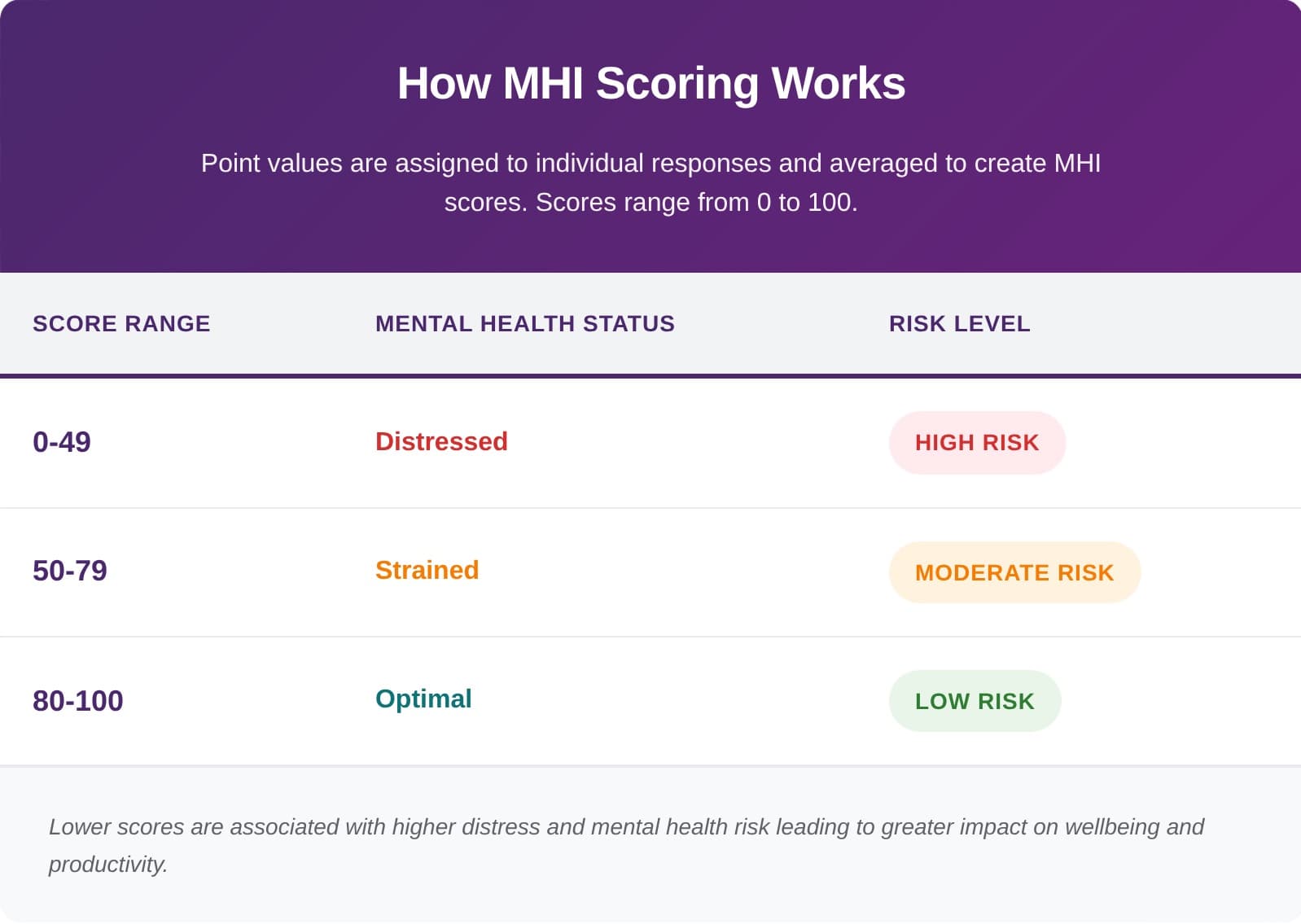
To create the MHI, a response scoring system is applied to turn individual responses into point values. Higher point values are associated with better mental health.
The sum of scores is divided by the total number of possible points to generate a score out of 100. The raw score is the mathematical mean of the individual scores. The distribution of scores is defined according to a sliding scale that ranks mental health status from distressed to strained to optimal.
How to use the Mental Health Index
Whether you’re identifying emerging risks or you’re measuring the impact of an existing wellbeing strategy, the MHI can help guide action across every stage of the employee experience.
“The MHI is part of a continuum of decision support tools that we offer,” explains Paula. “We developed it because you can’t make decisions about things that you don’t have data on, and we wanted to help employers understand what’s going on so they can make smart choices.”
Here’s how global organizations can leverage the MHI to support their own wellbeing initiatives.
Understand risk profile and inform resource allocation
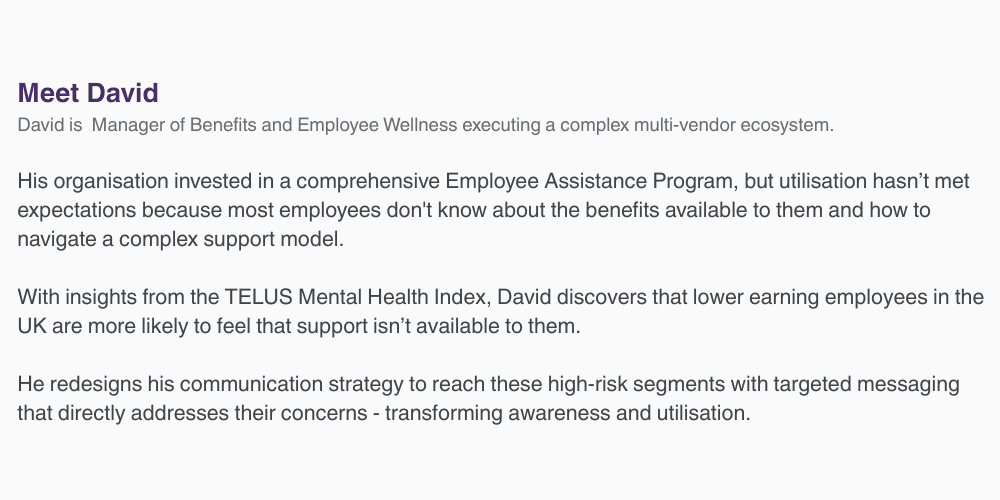
The MHI helps leaders establish a baseline for understanding where employees sit across the wellbeing continuum. This makes it easier to prioritize support where it’s needed most.
Instead of reacting to rising absenteeism or employee turnover, for example, leaders can use the MHI to highlight early warning signs that help to identify where support is needed before issues escalate. This helps organizations become more efficient in terms of resource allocation, allowing leaders to invest in targeted initiatives that make the greatest difference both for employees and the business.
Benchmark against your industry and region
Context matters, and a decline in employee wellbeing may reflect broader economic or social pressures, or it may point to challenges unique to your organization.
Comparing internal workforce data with external benchmarks helps leaders distinguish between widespread trends and organization-specific challenges, allowing leaders to respond to wellbeing challenges with greater confidence.
“We use the MHI to help organizations benchmark what they’re doing across different countries alongside the level of workforce risk they’re seeing. These insights help leaders prioritize where the need is, where the gaps are and where organizations should focus their attention.”
Paula Allen, Global leader, Research and Insights at TELUS Health
Track progress over time
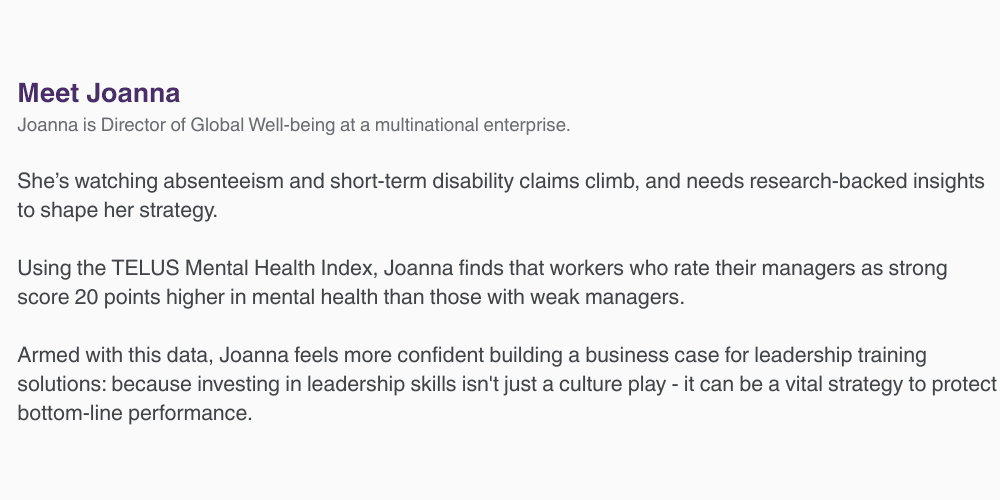
Organizations can leverage the MHI to monitor whether initiatives such as leadership development, mental health resources, financial wellbeing programs or cultural improvements are having the intended impact on organizational performance.
Over time, this creates a clearer picture of what’s working and where additional support may be needed.
Expert’s corner: Q&A with Paula Allen
Global leader, Research and Insights at TELUS Health, Paula Allen, shares her perspective on why measuring workforce wellbeing matters, how organizations can put MHI data into action and what leaders should be paying attention to next.
Why is it important for organizations to measure workforce mental health regularly?
“When we developed the MHI, we found there wasn’t anything available that gave employers consistent and timely data to help them understand what was happening inside their workplace over the long term. Many organizations conducted one-off employee surveys, but all you find out from those is what was happening at that point in time. Given that workforces are constantly changing, it’s important your data evolve too. Ultimately, you can’t improve what you don’t measure.”
What has surprised you most after nearly a decade of measuring workforce mental health?
“The impact of leaders. We always suspected there was a huge impact. We never expected it to be as strong as it was. It’s the individual leader that can really help people with their sense of purpose, help people feel safe or unsafe, ramp up or decrease anxiety, and influence isolation or collaboration within a team.”
What’s one thing you wish every HR and benefits leader understood about workplace wellbeing?
“They have more influence than they probably give themselves credit for. The things our workplaces do every day make a difference, and sometimes organizations take that for granted. The services offered literally change and save lives. The training provided to managers can shift a harmful environment to one that optimizes health and productivity. We want to make it as easy as possible for leaders to do everything they can to improve wellbeing, and that’s where the data comes in.”
Looking ahead, what do you think will become the biggest workplace wellbeing challenge?
“It’s change management. Change has always been stressful, but now it’s completely ongoing. Building a workforce that’s not fragile to change is going to be important for that workforce and for the mental health of the people who make up that workforce.”
Stay informed with the latest MHI insights
As new workplace challenges emerge and employee expectations continue to change, having access to timely and evidence-based insights can help leaders make more informed decisions not only about employee wellbeing, but about the people strategies that drive productivity and bottom-line growth.
“When organizations use the MHI to help inform their strategic plans, that’s brilliant, because the data helps them be laser focused on where they need to put their attention.”
- Paula Allen, Global leader, Research and Insights at TELUS Health
Frequently asked questions
Here are answers to some of the most common questions about the TELUS MHI, including how it’s developed, how the data is used and where you can access the latest reports.
How often is MHI data updated?
The TELUS Health MHI is published quarterly, providing organizations with timely insights into workforce wellbeing and emerging workplace trends. This regular reporting cadence makes it easier to track changes over time and identify new risks as they develop.
Is the data relevant to my company size or industry?
Yes. The MHI is designed to reflect the experiences of working populations across a wide range of industries, regions and demographic groups. The data can also be used alongside your organization’s own workforce insights to help benchmark performance and identify opportunities for improvement.
How does TELUS Health use this data?
TELUS Health uses MHI insights to better understand emerging workforce wellbeing trends, inform research and support organizations in developing evidence-based wellbeing strategies. The findings also help shape new products, services and thought leadership that address evolving workplace challenges.
Is the MHI based on TELUS Health customer data?
No. The MHI is based on independent surveys of employed individuals and people who have been employed within the previous six months. Participants are selected to represent the working population by age, gender, industry and geographic distribution, ensuring the findings reflect broader workforce trends rather than TELUS Health customer data.
Where can I access the latest MHI report?
Visit this page to access the latest report for your region. You can also subscribe to receive updated MHI reports directly in your inbox, including our annual TELUS Mental Health Barometer, which brings together a year’s worth of MHI findings to highlight emerging trends and provide practical recommendations for HR and business leaders.

Nadia Giorgis
Copywriter & Senior Marketing Communications Manager at TELUS Health
About the author
Nadia Giorgis is a Senior Marketing Manager at TELUS Health, specializing in research-driven content designed to help global enterprise leaders build resilient, highly engaged workforce cultures. With over 12 years of professional experience in strategic marketing and health communications, she brings deep expertise in translating complex data into relevant insights and actionable workforce strategies. Nadia is a graduate from the University of British Columbia and leverages a data-first approach to shape evidence-backed research into industry-defining perspectives, continually elevating the conversation surrounding organizational wellbeing.