

Key takeaways
- Listen to your team. Designing programs without employee input leads to low engagement and wasted resources.
- Personalise support. One-size-fits-all solutions fail to address diverse life stages and individual needs across your workforce.
- Focus on real outcomes. Track mental health and productivity improvements instead of just participation numbers.
- Meet legal obligations. Australian employers must manage psychosocial risks to ensure psychological safety under Work Health and Safety laws.
Research shows that workplace wellbeing programs drive real business results. Organisations that embed wellbeing into their culture experience 10 per cent higher retention rates and up to 20 per cent higher productivity, according to the Global Wellness Institute.
In Australia, managing employee mental health isn’t just a nice-to-have, but a legal requirement. Under Work Health and Safety laws, employers must manage psychosocial hazards in the workplace. To build effective workplace wellbeing strategies, leaders must understand what their teams truly need.
According to the TELUS Mental Health Index (MHI), 36 per cent of employees in Australia would prefer better support for their wellbeing over a 10 per cent pay raise (June 2025). This insight reveals that wellbeing is now a top priority for workers across industries. Organisations are responding to this demand – large companies spent an average of US$10.5 million (AU $14.6 million) on wellbeing programs in 2021, with the global corporate wellness market projected to top US$94.6 billion (AU $132.1 billion) by 2026.
Yet despite the clear demand and high investment, employee engagement dropped in 2024 for only the second time in 12 years – a decline as steep as during pandemic lockdowns, according to Gallup. In Australia, anxiety and depression remain widespread across industries, costing organisations 65.5 days in lost productivity per year per employee experiencing depression, and 61.1 days per year per employee experiencing anxiety, according to the MHI (September 2024). Meanwhile 61 per cent of workers feel somewhat or extremely burnt out and 34 per cent are finding it increasingly difficult to be motivated to do their work.
So where's the disconnect? The answer often lies in how programs are designed and delivered. Even well-built programs can underperform when engagement, alignment or communication aren't fully in place.
Here are five common oversights that prevent wellbeing programs from reaching their full potential.
1. Designing programs without employee input
The issue: Designing wellbeing programs from the top down without understanding what employees actually need.
The consequence: Low adoption rates and wasted resources.
The solution: Make meeting employees’ requests a top priority. According to HR research, 48 percent of HR professionals say that addressing the needs of a diverse, multigenerational workforce is a top priority, driving benefits decisions more than cost or customisation. Listening sessions, pulse surveys and open feedback channels can help organisations understand employees’ pain points and what they truly want. One UK company held over 50 employee workshops to co-design its wellbeing strategy.
When employees feel heard, they’re more likely to engage with programs. According to the MHI, 34 per cent of Australian workers identify health benefits as the greatest opportunity for improvement in their organisations, while 31 per cent say flexible work needs improvement (January 2025). By asking employees directly about these areas, you’ll uncover both wellbeing needs and what else matters to them, including flexible benefits and compensation options that can help support their financial health.
2. Prioritising scale over personalisation
The issue: Choosing one-size-fits-all solutions that ignore diverse employee needs and life stages.
The consequence: Critical life moments go unsupported, which impacts productivity, engagement and retention.
The solution: Shift to programs that offer personalised, holistic support as part of a comprehensive approach that supports employees across the wellbeing continuum—whether they’re feeling well, struggling or feeling unwell. These stages are not fixed points, but run along a spectrum that people naturally move across throughout their lives and careers. And each stage requires different types of support and intervention. For example, 84 per cent of mid-career women experiencing menopause symptoms report a negative effect on their work when unsupported. When organisations make menopause support visible, they see clear improvements in job satisfaction and engagement.
The same principle applies to employee benefits. Legacy benefits packages don’t resonate with diverse workforces. Workers today expect personalised options that address their unique financial needs and life situations.
Modern organisations shift from rigid, one-size-fits-all benefits to flexible options. This might include personalised salary packaging, customised health coverage or flexible allowances that increase take-home pay. When employees see benefits tailored to their stage of life, they feel valued and are more likely to stay. The same thinking strengthens workplace wellbeing initiatives built around human-centric design, where employees are 3.2x more likely to stay in their job.
Personalised benefits also act like an invisible pay rise. They increase disposable income without increasing your payroll budget. By combining mental health support with physical health and financial support, these offerings can help create a complete picture of employee care that drives both wellbeing and retention.
3. Measuring activity instead of outcomes
The issue: Tracking participation rates and app downloads instead of actual wellbeing impact.
The consequence: Programs look successful on paper but fail to improve employee wellbeing or productivity.
The solution: Shift to outcome-based measurement frameworks that use data collection to track program effectiveness through employee satisfaction, absenteeism and health indicators rather than simple participation rates. The MHI, for example, helps leaders see where strain is rising before it shows up in absenteeism, burnout or turnover. In a recent survey, workers in Australia with poor sleep had lower mental health scores, productivity and concentration than those who slept well (June 2025). This shows how small wellbeing shifts have a big impact on how employees show up at work.
When measuring program success, also look at what matters to your workforce. Workers rating their employer’s support for mental wellbeing as poor lose 58.4 working days per year in productivity, compared to 28.4 working days lost by those rating support as excellent. This 30-day difference translates directly to business impact. Measuring these real outcomes can help you demonstrate ROI to leadership and justify continued investment.
4. Underestimating implementation complexity
The issue: Focusing on technology platforms without addressing change management, communication and manager training.
The consequence: Tools exist but employees don’t use them or even know they’re there.
The solution: Invest in comprehensive rollout strategies that prioritise communication, education and ongoing support. Wellbeing-focused training equips managers with emotional intelligence and stress management skills, enabling them to model healthy behaviours and build psychologically safe environments. Regular check-ins help identify burnout risks early and help ensure employees understand the available resources, how to access them and that confidentiality is protected so they can feel reassured that using these resources won’t impact their career prospects. In one study, teams that held monthly 30-minute check-ins saw significantly lower burnout after a year.
According to the MHI, more than 40 per cent of workers in Australia say their manager has not communicated the availability of health and wellbeing programs to them (June 2025). Clear communication is critical. Many organisations struggle because they launch programs without adequate change management. Create a comprehensive rollout plan that includes manager training, employee communication campaigns and easy-to-access support channels, with privacy, transparency and consent built into program design from the start. Ensure your program reaches all touchpoints.
5. Ignoring the link between wellbeing and performance
The issue: Treating wellbeing as a standalone HR initiative that’s separate from business outcomes and company culture.
The consequence: Lack of leadership buy-in, unstable funding and difficulty sustaining programs long-term.
The solution: Integrate wellbeing into core business operations and workplace wellness strategy, from performance reviews to leadership goals and team metrics. When leaders see a clear ROI in productivity, retention and culture, investment becomes sustainable. Workplace wellbeing programs often fail when organisations ignore systemic workplace stressors. Research shows wellbeing initiatives can boost productivity by up to 21 per cent, with happier employees 13 per cent more productive, and organisations with a strong culture of health seeing lower turnover and stronger talent attraction.
In Australia, the impact of workplace stress and poor mental health conditions cost employers more than AUD $14 billion annually in lost productivity, absenteeism, presenteeism and staff turnover. However, research by PwC shows that for every dollar spent on comprehensive wellbeing support, organisations recoup AUD $3 through improved productivity and reduced claims. This strong ROI makes the business case clear: show your executive team that investing in employee wellbeing, including comprehensive benefits, health services and financial wellbeing as a critical component, is not a cost, but an investment with measurable returns.
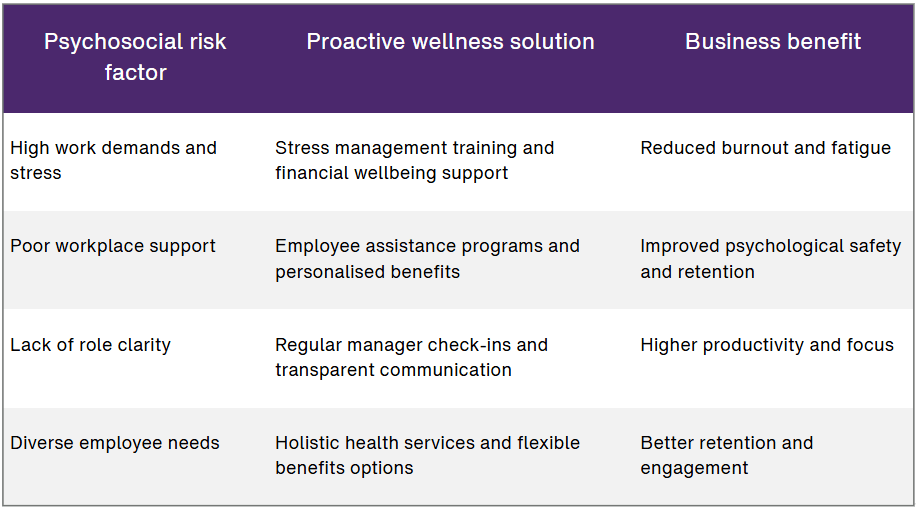
Having a work environment where overtime is normalised can negate the benefits of wellness perks, and expecting employees to participate during long hours only adds stress. The table below shows how organisations can align their wellness initiatives with common workplace challenges.
Workplace challenges and proactive wellness solutions
Your path forward
Avoiding these mistakes requires a structured wellbeing strategy:
- Assess your current state: Use benchmark data like the TELUS Mental Health Index to identify gaps between what you offer and what employees need. Also identify employee pain points and whether your benefits packages align with what employees actually want. Are your compensation and benefits offerings as personalised and flexible as your wellbeing programs?
- Engage employees in solution design: Involve diverse voices early and often – across departments, demographics and seniority levels. Their input helps ensure programs address real challenges around health, financial stress and work-life balance.
- Start small with targeted pilots: Test initiatives with specific teams before scaling. This allows you to refine your approach based on real feedback without overcommitting resources, while supporting behaviour change over time rather than expecting instant results.
- Measure, learn and iterate: Track meaningful outcomes such as employee satisfaction, retention, productivity and mental health scores. Use this data for continuous evaluation and improvement, since regularly reassessing initiatives keeps them fresh and engaging.
- Scale thoughtfully: Once pilots prove successful, expand across teams and geographies. Ensure you have the communication systems, manager training and support systems in place. Centralised hubs that easily integrate into existing HR systems can help employees access the right support when and how they need it, whether that’s mental health services or flexible benefits options.
Building programs that work
A comprehensive workplace wellness approach isn’t just an extra benefit, it’s a core part of business success. Organisations that get it right build resilient, high-performing teams where employees thrive and business objectives are met.
Success requires sustained leadership commitment, collaboration between HR, IT and operations and clear communication about program value and usage that goes beyond gym memberships and other superficial perks. By avoiding common planning and implementation mistakes, leaders can build sustainable programs that deliver real results. This includes recognising that employees value not just workplace mental health support, but also flexible, personalised benefits.
Ready to transform workplace wellbeing in your organisation?
Download the TELUS Mental Health Index for the latest data and benchmarks on workplace wellbeing.
Read the reportFrequently asked questions
What are the most common mistakes in workplace wellbeing programs?
The most common mistakes, and other common pitfalls in workplace wellness, include designing programs without employee input, choosing one-size-fits-all solutions, tracking participation instead of real health outcomes, ignoring manager training and treating wellbeing as separate from business performance. Many organisations also overlook the role of financial wellbeing and personalised benefits in supporting overall employee health, while superficial perks and poor alignment with company culture can also undermine engagement.
How do Australian Work Health and Safety laws affect workplace wellbeing?
Australian Work Health and Safety laws require employers to proactively manage psychosocial risks. This means organisations must identify workplace hazards that can harm employee mental health and take steps to eliminate or reduce them. This includes addressing excessive workload, poor support, workplace bullying and lack of flexibility. Compliance is both a legal obligation and a business imperative.
How can HR leaders measure the ROI of corporate wellness solutions?
HR leaders should focus on outcome-based metrics rather than simple participation rates. Track changes in absenteeism, employee retention, productivity levels and overall mental health scores using tools like the TELUS Mental Health Index. In Australia, workers rating employer support for mental wellbeing as excellent lose 30 fewer working days per year compared to those reporting poor support. This productivity gain alone justifies wellness investment.
Why is manager training important for employee wellbeing programs?
Managers are on the front lines of your organisation.Training equips them with the skills to recognise burnout, support struggling team members and build a psychologically safe work environment. This directly improves team performance and retention. Managers who communicate program availability and model healthy behaviours significantly increase program awareness and engagement across the organisation.
How do personalised benefits packages support a wellbeing program?
Personalised benefits packages complement mental health support by addressing financial stress, which directly impacts employee wellbeing. When employees have benefits tailored to their life stage, they experience increased disposable income and reduced financial anxiety. This creates a holistic approach to employee support where mental health services and financial wellbeing reinforce each other, driving better engagement and retention outcomes.