

Key takeaways
- Workplace mental health stigma persists in Australia despite awareness efforts, with 51 per cent of workers fearing career damage if they disclose mental health issues
- Employers in Australia have a legal duty under Work Health and Safety regulations to manage psychosocial risks and prevent mental harm at work
- Culture change requires more than offering mental health programs; it demands visible manager support, normalised language and psychological safety
- Just 54 per cent of Australian managers feel equipped to support employees dealing with mental health issues in the workplace
- Organisations that invest in stigma reduction see improved productivity, lower absenteeism and stronger employee retention
The gap between awareness and action
It's crucial to address one of the most pervasive barriers to mental wellbeing in our professional lives: workplace stigma. Despite years of wellness initiatives and awareness campaigns, the TELUS Mental Health Index (MHI) shows that mental health stigma continues to impact many employees in Australia, affecting their career trajectories, self-perception and overall wellbeing.
In Australia, workplace mental health has become more than a wellbeing issue, it's a legal and strategic priority. Under Work Health and Safety regulations, employers have a duty to proactively manage psychosocial risks and prevent mental harm at work. This makes reducing mental health stigma not just ethically important, but a critical compliance requirement.
Despite heightened mental health awareness, according to the June 2025 MHI 51 per cent of workers in Australia would be concerned that their career options would be limited if their workplace was aware that they had a mental health issue. This gap between awareness and action reveals a fundamental challenge: culture change and stigma reduction require more than wellness campaigns. They demand a strategic shift in how organisations communicate about mental health, how managers respond to struggling employees and how work is designed to support psychological safety.
Why employers in Australia must prioritise culture change and stigma reduction
Employers in Australia face both moral and legal obligations to address mental health stigma. The Work Health and Safety Act requires organisations to identify and eliminate psychosocial hazards such as stigma, isolation and discrimination that could harm employees’ mental health.
Beyond compliance, there’s a strong business case. Poor mental health costs the Australian economy more than AUD $70 billion each year in lost productivity and participation. The MHI shows that workers who rate their employer’s mental wellbeing support as excellent have mental health scores 15+ points higher than those rating their support as poor. These employees also experience 30 fewer days of productivity loss annually (September 2024). This direct link between perceived employer support and employee outcomes demonstrates the business impact that reducing stigma can have.
Work plays a significant role in the lives of 14.4 million Australians, making workplaces a key setting to help support and improve mental health. The challenge is real: many employers in Australia offer comprehensive mental health programs, yet utilisation remains low, which may be due to employees’ fear of stigma and concerns around privacy. A workplace mental health strategy that includes culture change, manager training and clear communication can help transform these underused benefits into valued employee resources.
How workplace mental health stigma manifests: Australian insights and global patterns
The MHI analysis of employed adults across multiple countries reveals that while mental health stigma in the workplace manifests differently across cultures, it shares common threads that impact employees universally. From North America to Asia and Europe, the data shows concerning patterns that demand immediate attention.
The majority of workers express concerns about disclosing mental health issues in the workplace due to potential career consequences. Workers under 40 in Australia are 50 per cent more likely than workers over 50 to feel negatively about themselves for experiencing mental health challenges (June 2025). This highlights the impact stigma has on emerging talent and the future leadership pipeline.
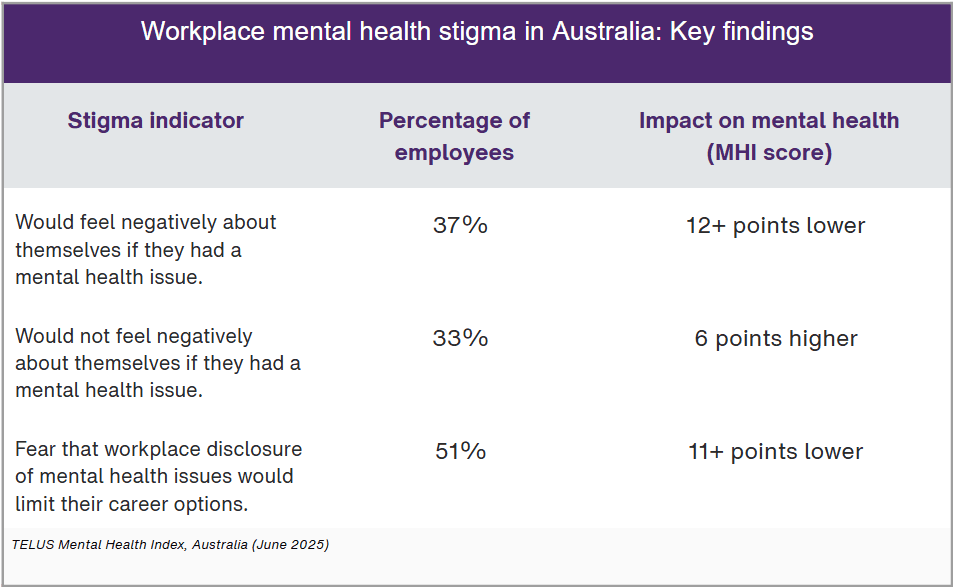
This self-stigma, combined with workplace concerns, creates a double barrier to seeking help. Stigma includes negative stereotypes, prejudice and discrimination, which can cause workers dealing with mental health issues at work—whether depression, anxiety or other conditions—to delay or avoid seeking support because of internal shame and fear of career consequences.
The National Survey of Mental Health-Related Stigma and Discrimination estimates that over four million Australians experienced mental health-related stigma and discrimination in the 12 months before the survey.
Despite heightened mental health awareness in Australia, stigma has barely improved. According to the June 2025 MHI, self-stigma has declined by only three per cent and fear of workplace stigma has decreased by just one per cent since February 2021. This stalled progress shows that awareness campaigns alone don’t shift culture.
The manager training gap: Equipping leaders to support employees dealing with mental health issues in the workplace
One of the biggest barriers to reducing mental health stigma is the lack of manager capability. Research shows that just 54 per cent of managers in Australia would know what to do if they suspected an employee was struggling with a mental health issue. Even more concerning, 46 per cent are either unsure or unprepared, meaning nearly half of managers lack the foundational knowledge and confidence to respond supportively.
Workplace mental health training for managers is essential, and effective training programs such as Mental Health First Aid (MHFA) train staff to recognise and respond to colleagues experiencing mental health issues. Managers are often the first point of contact when an employee faces challenges. Their response sets the tone for whether the employee feels psychologically safe to disclose their struggle or hides it, perpetuating stigma.
Manager confidence in supporting mental health
Effective mental health workplace training should cover:
- Recognising early warning signs of distress or burnout
- Building practical skills for supportive conversations without being intrusive or judgmental
- Knowing when and how to guide employees to appropriate support services
- Understanding workplace accommodations for mental health conditions
- Modelling healthy boundaries and self-care
Organisations that invest in manager training see measurable improvements. Managers who have received training on supporting a mentally healthy workplace report mental health scores that are 6 points higher compared to those who haven’t participated (June 2025).
The communication challenge: Why normalising mental health language is essential
Beyond the awareness gap, there's a language problem. Many organisations discuss 'wellness' and 'stress management' while avoiding explicit discussion of 'mental health,' 'depression,' 'anxiety,' and other conditions. This euphemistic language signals discomfort and inadvertently reinforces stigma.
According to TELUS Health data, more than eight in 10 workers in Australia say their organisation's communication about health and wellbeing programs is unclear or inconsistent (June 2025). Worse, 25 per cent say they rarely or never receive information about these programs.
A workplace mental health policy that explicitly addresses mental health—not just wellbeing—sends a clear message: mental health challenges are normal, they're addressed like any other health issue, and support is available. HR leaders should help ensure that:
- Employee handbooks and benefits guides explicitly mention mental health conditions alongside physical health
- Mental health terminology appears in onboarding materials and quarterly communications
- Managers receive talking points to normalise mental health conversations in regular one-on-ones
- Mental health resources are promoted as regularly and consistently as physical health services
- Confidential mental health support is positioned as a standard benefit, not a crisis intervention
This normalisation is the foundation for building a psychologically safe workplace where employees feel comfortable seeking help early, reducing both stigma and long-term costs. When 55 per cent of workers don’t know or say their employer doesn’t offer an employee assistance program, the problem isn't the program—it's communication.
Leadership storytelling: Making mental health support visible and safe
Managers and executives have outsized influence on stigma reduction. When senior leaders openly discuss their own experiences with stress, burnout, anxiety or using mental health support, it fundamentally changes workplace culture. Employees take cues from leadership: if leaders model seeking help, employees will too.
As Sandy McIntosh, Executive Vice-president, People & Culture and CHRO at TELUS recently shared, “When you have leaders who have the courage to lead from the front on well-being, we need to amplify their voices. One of our senior leaders started a team meeting by speaking openly and vulnerably about his own mental health journey and experiences with panic attacks. That single act of leadership character completely transformed the conversation within his team. By putting comfort aside and choosing transparency, he unlocked a new level of trust, safety and open dialogue. By continuing to share his story, he sparked a positive ripple effect that inspired teams across our company and prompted meaningful dialogue beyond our walls.”
Nearly 1 in 5 adults in Australia experience poor mental health each year, which is why visible leadership matters and can help encourage people to protect their own mental health.
Effective leadership storytelling doesn’t require oversharing. A chief executive officer mentioning that they use annual mental health days, a director explaining how therapy helped them navigate a difficult period, or a manager acknowledging they had to adjust workload due to burnout—these moments break stigma and signal that mental health challenges are human, not career-limiting.
Organisations can build storytelling into regular touchpoints: town halls, internal newsletters, manager one-on-ones and onboarding. This visibility can help transform a workplace mental health program from a hidden, shame-based benefit into a normal part of how the organisation operates. When leaders are vulnerable about their own experiences, they give permission for others to do the same.
Building a workplace mental health strategy: Steps for HR leaders
Reducing mental health stigma isn’t a one-time initiative; it’s an ongoing workplace mental health strategy embedded into HR operations. HR leaders should consider this roadmap over the next 12 months:
- Assess current state. Conduct pulse surveys asking employees about stigma perceptions, comfort discussing mental health, awareness of mental health resources and manager support. Audit existing mental health policies and benefits communication. Review employee assistance program utilisation rates, mental health-related leave patterns, and engagement survey scores on psychological safety.
- Engage leadership. Brief executives on compliance with health and safety laws, business impact (productivity losses and retention) and the strategy for culture change, using Safe Work Australia’s Model Code of Practice: Managing psychosocial hazards at work as guidance. Secure commitment to visible leadership support, storytelling and resource allocation.
- Redesign communication. Revise employee handbooks, benefits guides and onboarding materials to explicitly use ‘mental health’ language. Create regular communication campaigns to raise awareness of services as confidential, accessible and free. Position workplace mental health support as a standard employee benefit, alongside medical and dental coverage.
- Launch manager training. Deliver mental health workplace training covering recognition of distress, supportive conversation techniques and navigation of workplace accommodations for mental health conditions. Make training mandatory and part of annual manager development. Provide managers with response guides, conversation starters, and practical tools. Training should equip managers, leaders and supervisors with strategies to help support mental health at work, protect psychological health, clarify responsibilities and respond appropriately after traumatic events.
- Measure and iterate. Track employee assistance program utilisation, mental health-related leave duration, engagement survey scores on psychological safety and manager support and manager confidence levels (pre and post training). Adjust programs based on feedback and data. Compare results annually to identify where stigma persists and where interventions are succeeding.

Ready to build a psychologically safe workplace?
Culture change and stigma reduction don't happen by accident—they require commitment, resources and the right support. Start your journey toward a healthier, more engaged workplace today.
Learn moreFrequently asked questions
What is a mentally healthy workplace, and why does culture matter?
A mentally healthy workplace is one where employees feel psychologically safe to discuss mental health, access support without fear of stigma or career consequences, and work in an environment where mental health is managed proactively alongside physical health. Culture drives whether employees actually use available mental health programs. Having an employee assistance program is access, but creating an environment where employees feel safe using it is acceptance.
What's the legal requirement for Australian employers regarding workplace mental health?
Under the Work Health and Safety Act, Australian employers have a duty to identify and eliminate psychosocial hazards, including workplace stigma, isolation and discrimination that could harm mental health. Reducing mental health stigma is part of managing psychosocial risk effectively and demonstrating due diligence. Employers who fail to address these hazards could face regulatory action and potential liability.
How can managers help when employees are dealing with mental health issues in the workplace?
Managers should: (1) learn to recognise signs of distress or burnout; (2) initiate supportive conversations without judgment; (3) direct employees to mental health resources like your employee assistance program; (4) understand available workplace accommodations for mental health conditions; and (5) model healthy boundaries and self-care. Manager training is essential and should be mandatory in most organisations.
Why is normalising mental health language important for reducing stigma?
Stigma thrives in silence. When organisations use euphemisms like 'wellness' instead of 'mental health,' they inadvertently reinforce the message that mental health is taboo. Explicit language normalises mental health as a regular part of the employee experience, not a crisis issue. Update policies, benefits guides and communications to openly discuss mental health, depression, anxiety and other conditions. This shift in language signals safety and accessibility.
How can we measure whether our culture change and stigma reduction efforts are working?
Track: (1) employee assistance program utilisation rates; (2) mental health-related leave usage; (3) employee survey responses about comfort discussing mental health and perceived manager support; (4) manager confidence levels (measured before and after training); and (5) overall engagement and retention in high-stress or high-risk roles. Compare results annually to identify where stigma persists and where interventions are succeeding. You can also monitor workplace complaints related to discrimination or bullying, which often correlate with low psychological safety.