

Key takeaways
- Data drives decisions. Reliable data helps HR leaders move away from guesswork and make informed choices for workplace wellbeing and benefits strategy.
- Legal compliance is critical. Australian employers must proactively manage psychosocial risks to meet WHS legal standards.
- EAPs offer measurable value. A modern employee assistance program helps address mental health risks before they become major workplace hazards and reduces productivity losses.
- Insights improve outcomes. Using regional data can help organisations design targeted wellbeing programs and support systems that actually work.
We're proud of the work our team does, and we want you to get to know the faces behind TELUS Health. Meet Paula Allen, Global Leader of Research, Insights and Strategic Communications at TELUS Health.
Paula is a trained mental health clinician with a focus on children and brain function. She’s held senior leadership roles in disability management, leadership training, product development and health and benefits consulting.
In addition to her work with TELUS Health, Paula is the incoming Board Chair of one of the largest networks of autism services, serves on the technical committee for the National Standard for Psychological Health and Safety in the Workplace, is a director on the Canadian Club Board, is a founding board member for the Canadian Business Disability Inclusion Network and has chaired the Quality Committee while on the board of the Women’s College Hospital.
At TELUS Health, Paula leads the production of the TELUS Mental Health Index (MHI). This index surveys 19,000 workers from around the world quarterly, including the Australian workforce. The data from the report informs employers and governments on the mental health of workforces globally, and helps them determine how they can better support their people and improve employee health outcomes.
Read on to hear more about what ignites Paula's passion for wellbeing, and how her work contributes to building healthier workplaces and communities around the world.
How data improves employee mental health and workplace wellbeing
Q: How long have you been a part of TELUS Health, and what inspired you to join the team?
A: I was inspired to join several years ago because I saw a willingness to push the limits and set higher standards for whatever needs to be done. I would not be interested in a company that had no ambition other than doing what had been done before. What’s the point? Thankfully, that spirit continues through the years.
Q: What would you say the main areas of focus in your role are?
A: My team and I do research, data analytics and communications to support three key areas.
1. Public awareness and insights into issues that matter for health, quality of life and productivity, globally. This is where the MHI comes in. It also includes the events we speak at and our collaborations in thought leadership. The goal is to raise the bar for everyone. Good information leads to good decisions, which then leads to better results for people, businesses and communities.
2. Individual customers and partners of TELUS Health. This is where we help tackle barriers to better health. We do this by leveraging data in four ways:
- Analysing data that answers questions specific to a particular organisation, industry or demographic
- Conducting research projects that investigate issues that may be specific to a group, but where good data is missing
- Leveraging research and data to inform the communication strategy needed to engage individuals and groups in behaviours that support health, and delivering on that strategy.
- Developing tools and systems to make all of this as scalable as possible
3. Decision support for TELUS Health. My team provides data that helps inform our products. We also manage the system of data points and analytics that keep us aware of the needs and sentiment of our customers.
Each of these three areas links to the others. They’re all about making better decisions, finding the insights needed for better health outcomes, and addressing health in a way that truly matters.
Building psychological safety in the workplace through data
Q: What’s your favourite part about your role with TELUS Health?
A: Thinking things through with my team and others. I love the times when people come with their minds, passion and openness to learn and create. We have some brilliant minds that challenge critical assumptions. They analyse and interpret the data that helps us all make solid decisions.
That’s the process. We start with observations and ideas, validate them with data, and then we take action. Decisions without data are just whims. Whims might be good for selecting a flavour of ice cream, but they’re rarely good when running a business, especially one that impacts people’s health.
That's why we help employers measure both the financial return on investment (ROI) and the broader value on investment (VOI) of their wellbeing benefits. So they can justify their spending and demonstrate real impact, because workplace mental health is now a business imperative. Companies investing in workplace mental health see a 4x return.
In Australia, employers have a legal duty to manage psychosocial hazards under workplace health and safety laws. This means organisations must take proactive steps to ensure psychological safety in the workplace. Data is the best tool to help HR leaders identify these hazards before they cause harm.
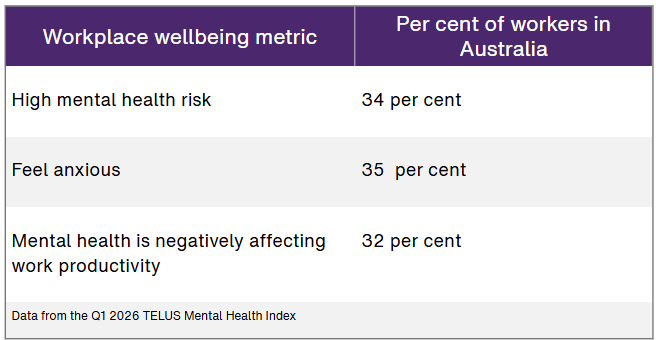
According to the Q1 2026 TELUS Mental Health Index for Australia, many workers face significant mental health challenges. The global economy loses $1 trillion annually due to anxiety and depression, with burnout costing the global economy $322 billion annually. The data highlights the urgent need for structured support.
The role of employee wellbeing programs and EAPs in risk management
Q: How do you feel your work positively impacts the lives of employees around the world?
A: My team brings clarity. When you have a sense of clarity, you have greater control and are then able to improve on the things that matter.
We provide clarity for the general market—individuals and organisations—with our reports, such as the MHI. We provide clarity for organisations and their people with our analytics. We also provide clarity in the communications and change management strategies we develop.
In addition to providing our clients clarity through data, we support our TELUS Health colleagues with client and product insights, market research and data driven tools that support our sales people. This helps us design better tools to support workplace wellbeing.
My team has a global view of the mental health and wellbeing of people around the world. TELUS Health operates in many countries, and we’re proud to help enhance the wellbeing of employees on a global scale.
Q: How does mental health data better inform employers on how to support their people?
A: All of the work we do helps each part of a healthy society, from employers to colleges and individuals. Data helps everyone. We answer specific questions and package them in ways that make sense to different groups. By getting hard evidence on how people are doing, including through pulse surveys that track employee experiences and stress levels, employers can shape wellbeing initiatives, wellness initiatives and workplace mental health support services with more confidence and use early intervention when patterns show people reporting high stress.
For example, using insights from mental health research and EAPs, we can develop TELUS Health Learning courses to help address specific business challenges and employee needs, such as mental wellbeing and overall job satisfaction. For employers focused on cost management, we have the data that shows that EAP use connects to decreased distress, increased productivity and better engagement —all of which can improve the bottom line.
One of the strongest benefits of our data is that it comes from multiple perspectives and services. This gives us clearer and more accurate insights than any single point of view can offer.
Q: What’s your vision for the future of employee healthcare?
A: I see the future of employee wellbeing as focused on the empowerment of individuals. People need to have access to the tools and knowledge so that they can take control of their own mental health journey. Data that is delivered in a clear and usable manner is critical to that.
Q: How do TELUS Health's values resonate with you and support your personal health and wellbeing?
A: All of TELUS Health’s values support a healthy life and a healthy mind. This is directly reflected in how we approach solutions that support employee mental, physical and financial health. When employers invest strategically in these areas, they're not just supporting employee health, they’re protecting their workforce resilience and improving their retention ROI.
Once you have those, other things will fall into place.
What's next?
Understanding the mental health challenges your workforce faces is the first step. Taking action is where ROI happens. Explore the TELUS Health Mental Health Index to benchmark your organisation against broader workforce trends and identify where stress is building in your teams.
Download the latest reportFrequently asked questions
What are the legal requirements for psychological safety in the workplace in Australia?
Under Australian WHS laws, employers must eliminate or minimise psychosocial risks at work. This includes managing hazards like excessive workloads, bullying and poor environmental conditions. Employers must treat psychological risks with the same importance as physical safety risks.
How does an employee assistance program help with WHS compliance?
An employee assistance program provides workers with immediate, confidential access to mental health support. This can help organisations meet their legal duty of care by offering proactive support to mitigate workplace stress and mental health hazards.
How can HR leaders use data to improve workplace wellbeing and the ROI of benefits?
HR leaders can use data from sources like the TELUS Mental Health Index to identify trends in burnout, stress and absenteeism. They should track key metrics such as absenteeism rates, retention rates, employee satisfaction and stress levels. Additionally, our Psychosocial risk assessment can be used to determine the drivers of risk and workplace outcomes. Together they allow organisations to design targeted wellbeing programs and training rather than relying on guesswork.
What’s the connection between employee mental health and workplace productivity?
Poor mental wellbeing often leads to presenteeism, where employees are physically present but not fully productive. According to the TELUS Mental Health Index for Australia, workers with poor mental wellbeing support lose nearly 30 additional working days of productivity annually compared to those with excellent support (September 2024). Addressing mental health risks early improves focus, engagement and overall business productivity.
Why should employers measure both ROI and value on investment (VOI) for their benefits?
ROI measures direct financial savings like improved productivity, reduced absenteeism and lower workers' compensation claims. VOI captures broader human metrics like employee engagement, retention and job satisfaction. Together, they help HR leaders present a complete business case and justify wellbeing spending with both hard numbers and culture impact.