

Key takeaways
- Trust drives results: Employees with excellent managers are 6.5 times more likely to be fully engaged and far more likely to stay and recommend their organisation.
- Managers are the wellbeing front line: The TELUS Mental Health Index finds 20 per cent of employees in the UK perceive support from their organisation as poor, a perception shaped largely by their line manager.
- The cost of inaction is high in the UK: The Health and Safety Executive reports 964,000 workers with work-related stress, depression or anxiety and 22.1 million working days lost in the latest reporting year.
- Manager training supports HSE compliance: Trained managers act as a control measure under the HSE Management Standards for psychosocial risk and help meet your duty of care.
- Coaching delivers measurable ROI: FMI research shows 84 per cent of leaders report greater effectiveness through coaching and 87 per cent say it delivers a strong return.
Why developing leadership delivers better business results
Today's managers do far more than supervise tasks. They're the primary gatekeepers of workforce wellbeing. For HR professionals, organisational leaders and businesses looking to improve leadership capability, this is where the leadership gap shows up most clearly and where the right development programme can close it.
Building trust is the foundation of developing leadership: it means giving managers the confidence, skills and support to lead effectively, strengthen employee wellbeing and improve business results through focused leadership coaching and training. Great managers do more than delegate tasks and track deliverables. They build trust with the people they lead. And trust delivers results.
The 2025 TELUS Mental Health Barometer shows that employees who trust their managers are more likely to rate them as excellent. Employees with excellent managers are 6.5 times more likely to be fully engaged, 3.2 times more likely to recommend their organisation as a great place to work and 2.4 times more likely to be satisfied with growth opportunities. This is the kind of leadership that drives retention, performance and day-to-day support for employee mental health.
Yet most organisations haven't adequately equipped their leaders. According to a recent NAMI-Ipsos poll, 78 per cent of managers feel prepared to support their direct reports' mental health, yet just 63 per cent believe their company provides the necessary tools and resources. In the UK, the TELUS Mental Health Index (MHI) found that 20 per cent of employees perceive support from their organisation as poor.
That perception is shaped almost entirely by the direct line manager, which makes a strong leadership development programme more essential than ever, especially for organisations that need better engagement, retention and alignment with health and safety expectations.
Leadership can be practised without a formal title, which is why organisations that want to develop leaders need to build trust, respect and support well beyond senior roles. When those conditions are absent, employees are more likely to feel isolated and disengaged. Many report little to no access to mental health education or wellbeing resources.
This disconnect between what employees need and what they experience can erode morale, drives turnover and raises the stakes for better manager support. It's why organisations are revisiting how they develop employees into leaders through manager training and ongoing corporate coaching solutions that reinforce capability and confidence.
The strategic imperative: Leadership coaching as a competitive advantage
A promotion into leadership is universally celebrated as a professional milestone. Yet few realise that 40 to 50 per cent of new leaders fail within 18 months. Better hiring alone won't fix this. Better development will, and it starts with leadership coaching.
Corporate coaching solutions can be a valuable tool for the personal development and performance of business leaders. Coaching helps them acquire essential skills, improve decision-making, strengthen resilience and create stronger corporate cultures. An FMI report found that 84 per cent of leaders report greater effectiveness through coaching and 87 per cent say it delivers a strong ROI.
Coaching provides personalised support tailored to each leader's specific challenges, whether navigating a promotion, leading through transformation or strengthening their executive presence.
Despite this, many organisations struggle to close the capability gap. Research by the Chartered Institute of Personnel and Development (CIPD) shows that 75 per cent of leaders acknowledge their direct impact on employee wellbeing, and 80 per cent of supervisors recognise their role in supporting workforce wellness. Yet organisational priorities don't reflect the strategic intent. Studies show that executives discuss customers 10 times more than employees, and this ratio has widened over the last 15 years.
More training alone won't close the gap. Purposeful coaching will. That means a personalised journey rooted in continuous learning that connects leadership growth with business priorities, measures real progress and helps leaders grow with empathy and trust.
The UK leadership development challenge
If coaching delivers such measurable returns, why aren't more organisations investing? The answer lies in ROI anxiety around measurement. This hesitation shows up in research from the TELUS Mental Health Index on manager preparedness, even as organisations also expect managers to embrace new technologies and market trends, adding to the pressure on leadership capability. The MHI tracks employee wellbeing quarterly across 12 countries using a zero to 100 scoring scale, where scores below 80 indicate mental health strain.
For example, in Germany, only 49 per cent of people leaders say they would know what to do if an employee was struggling with a mental health issue. In Australia, just over half (54 per cent) of people leaders feel equipped to address employee mental health issues.
The stakes are just as high in the UK. Nearly one-third (32 per cent) of managers are unsure and an additional nine per cent wouldn't know what to do if they suspected an employee was struggling with a mental health issue (June 2025). With 964,000 workers in Great Britain suffering from work-related stress, depression or anxiety, and 22.1 million working days lost as a result, managers sit at the centre of this challenge and must make sound decisions under pressure.
The struggling phase: Where untrained managers miss the moment due to lack of leadership skills
Most employees don't move from healthy to crisis overnight. They pass through a struggling phase first, and line managers are more likely to notice early warning signs like presenteeism, withdrawal and subtle drops in performance through regular feedback. Line managers are the crucial first contact during this phase.
Without manager training, these signals are often misread as performance problems rather than signs of distress, so employees fail to receive the guidance, warm referrals to their employee assistance programme (EAP), coaching or occupational health support they need, and, as a result, early problems escalate into sickness absence and turnover.
When managers lack these skills, their own wellbeing takes a hit too. The 2025 TELUS Mental Health Barometer shows that 33 per cent of workers in Europe find it increasingly difficult to be motivated to do their work, while 29 per cent of employees say their mental health is hurting productivity.
Manager training and HSE duty of care: The regulatory case for developing leadership
In the UK, manager capability is also a formal compliance matter. The HSE Management Standards require employers to assess and manage psychosocial risks such as excessive demands, lack of control and poor workplace relationships. Trained managers act as a control measure within this framework. They spot risks early, adjust workloads and respond appropriately when someone is struggling.
Structured manager training also helps organisations meet their duty of care and reduce exposure to stress-related absence and its costs. Standardising how managers respond across business units gives HR teams evidence that reasonable steps were taken to protect employee wellbeing. Organisations that track mental health data can also anticipate these challenges before they escalate. For HR departments responsible for workplace health and safety, developing leadership capability belongs in the risk management plan alongside physical hazards.
What to look for in a corporate coaching partner
Not all corporate coaching solutions are designed to deliver measurable capability development or scalable impact. The right partner should demonstrate proven methodology, relevant program content, global coaching expertise and the ability to support leaders at all levels of the leadership development programme, from frontline managers and emerging leaders to senior executives.
When evaluating strategic leadership development tools for HR teams, organisations should look for:
- Structured coaching methodology: follow a professional framework with defined stages to ensure clarity and accountability. A coaching process should include four stages: briefing, discovery, coaching sessions and multi-stakeholder review to align goals and track progress.The programme should connect coaching to real work situations because effective leadership development involves 70 per cent learning from experiences.
- Practical tools for leaders: coaching should help leaders recognise and respond to the challenges their teams face, from managing stress and performance feedback to navigating conflict and preventing burnout or disengagement, while supporting clear outcomes when leaders manage teams. With the right awareness and resources, leaders can foster a culture of care.
- Manager-specific capability building: strengthen practical leadership capacity, including behaviours that enable healthy team culture, such as trust, empathy, psychological safety, open communication, conflict resolution, emotional intelligence, and the ability to recognise and respond to employee and team distress.
- Flexible delivery across teams and locations: be accessible and practical for today's workforce. Look for a partner that offers individual and group coaching delivered in person or virtually, making it easier to support leaders across countries, time zones and organisational levels.
- Low-admin delivery for busy HR teams: low-admin leadership development solutions offer automated scheduling, integration with your learning systems and centralised progress reporting. This makes enterprise rollout possible without straining internal HR resources.
- Measurable progress and accountability: include review meetings throughout the coaching journey to align on KPIs, assess progress and ensure alignment with business expectations, measured against behavioural change and business outcomes, with reporting providing valuable insights.
Structuring leadership wellbeing and emotional intelligence programmes across management tiers
Frontline managers and senior executives shape wellbeing in different ways, so effective leadership wellbeing programmes segment their approach by tier to reflect different leadership styles.
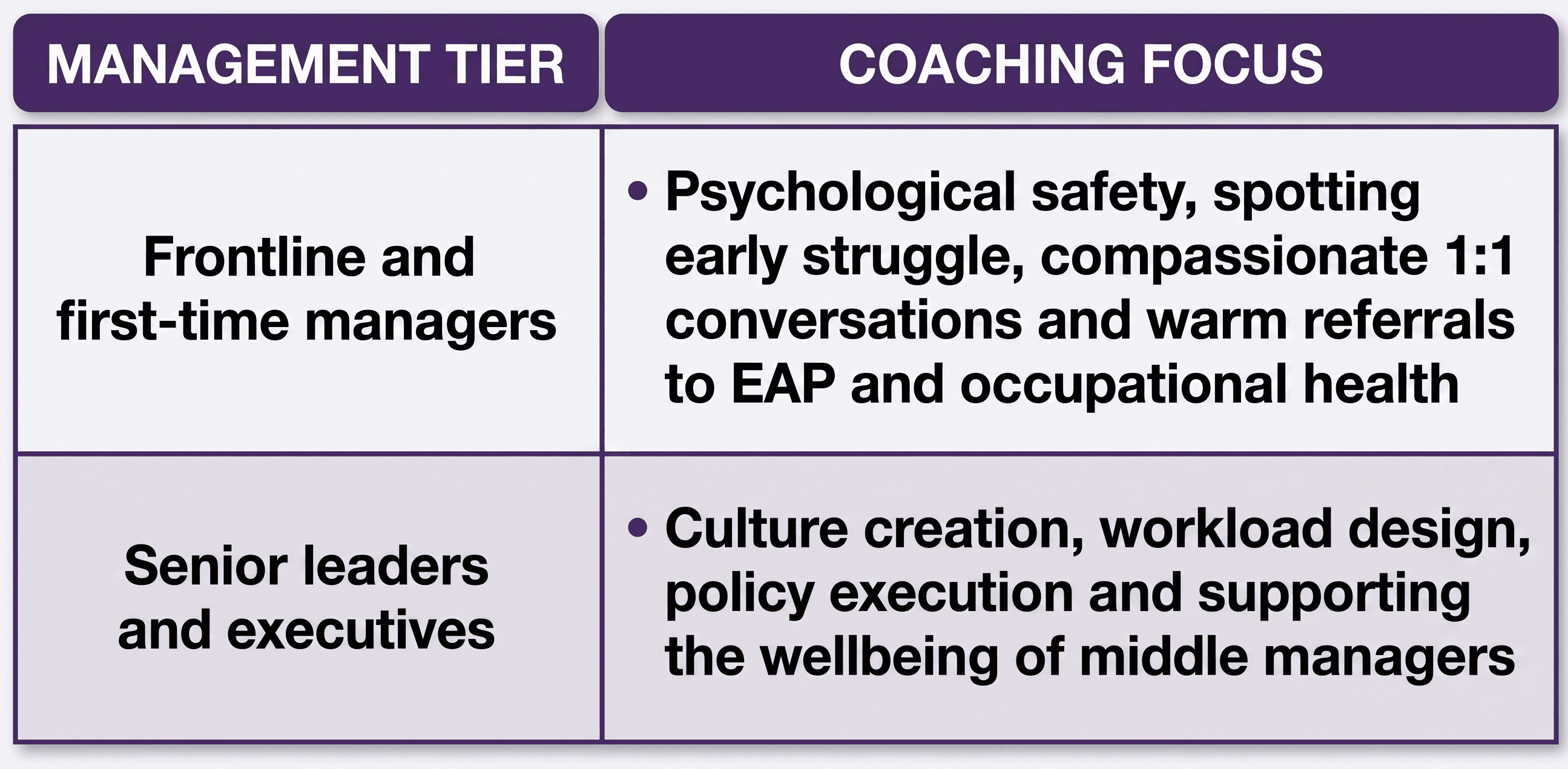
Executive wellbeing programmes incorporate leadership development by combining strategic executive coaching with personal resilience training. When senior leaders model healthy boundaries, speak openly about wellbeing and communicate a clear vision, they can shape culture across management tiers, reduce stigma, and make it easier for managers at every level to do the same.
What good leadership coaching looks like in practice
Coach expertise matters. Work with coaches who have a strong business background in leadership positions and a proven track record of developing senior leaders, backed by accumulated coaching hours and ongoing supervision. Coaches should be strategic partners who work in alignment with business objectives and help leaders identify their leadership strengths and weaknesses rather than just facilitators.
Beyond business skills, coaching should build the core wellbeing competencies every line manager needs:
- Spotting early warning signs: recognising subtle indicators of burnout, financial stress and caregiving strain.
- Compassionate conversations: conducting structured, non-stigmatising 1:1 check-ins, because great leaders listen more than they speak.
- Active referral pathways: confidently connecting employees to EAP, coaching and occupational health services.
- Self-care and boundary modelling: protecting managers' own mental wellbeing so stress doesn't cascade from manager to team, while owning up to mistakes and sharing credit for successes.
Targeted leadership coaching builds capability that sticks and supports developing leadership skills in ways traditional training alone can't. When built into a leader development plan, coaching helps ensure leaders gain lasting confidence and skill and the ability to apply them in real time. In today's workplace, these leadership skills are central to a strong leadership development programme and long-term success.
Explore how TELUS Health employee health and wellbeing solutions and executive coaching can help you build leaders who support both performance and wellbeing across your organisation.
Get insights to help support stronger leadership
Explore the latest TELUS Mental Health Index to understand workforce trends and the impact of leadership.
Learn moreFrequently asked questions
Why should UK organisations connect leadership development to employee wellbeing?
Direct managers are one of the biggest influences on employee mental health and engagement because their daily behaviour and influence shape trust, pressure and psychological safety. Focusing development on psychological safety, early struggle recognition and supportive communication reduces sickness absence, improves retention and supports compliance with HSE psychosocial risk standards.
How do leadership training programmes develop manager capabilities for team performance and retention?
Growing teams often promote technical experts into management without people-leadership training. Targeted programmes build skills in psychological safety, workload management, conflict resolution and setting clear expectations, helping managers build self-awareness and become more effective leaders. High-trust managers prevent burnout from escalating, lift team performance and reduce costly attrition, which creates measurable improvement teams can value and achieve with consistent commitment.
How do executive wellbeing programmes incorporate leadership development?
They combine strategic coaching with personal resilience training. Senior leaders learn how their decisions, communication style and boundary-setting shape workplace culture, so they model healthy behaviours, including taking responsibility, and back wellbeing policies with action across every tier of the organisation.
Which leadership development programmes help build psychological safety and authentic leadership in organisations?
The most effective programmes use structured courses, personalised coaching and other strategies, such as 1:1 sessions combined with peer cohorts, rather than one-off seminars. They focus on practical behaviour change so managers can inspire people, build strong relationships and create a stronger sense of trust, from listening without judgment to discussing mental health without stigma and creating clear referral pathways to EAP and occupational health.
What are low-admin leadership development solutions and why do HR teams need them?
They're technology-enabled coaching platforms that reduce administrative work for HR through automated scheduling, integrated progress dashboards and centralised reporting. This lets HR teams deliver personalised coaching across large or hybrid workforces without straining internal resources, while helping managers and HR identify trends, understand progress and see what successful leaders, best leaders and great leaders do differently. Regularly asking for feedback improves leadership effectiveness.