

Key takeaways
- Mental health costs UK employers £51 billion annually. A proactive approach can help prevent expensive crisis interventions and long-term sickness absence.
- Every £1 invested in workplace mental health returns £4.70 in business value. Use this benchmark to help justify wellbeing spending to finance leaders and measure ROI through absence reduction and retention.
- Burnout stems from workplace systems, not individual weakness. Address root causes like constant connectivity, excessive workloads and presenteeism-focused culture through structural changes.
- Line managers are responsible for early intervention under UK law. The Health and Safety at Work etc. Act 1974 requires employers to manage psychosocial risks, making manager training both a legal duty and business necessity.
- Two-thirds of workers don't know if they have EAP access. Clear, repeated communication across multiple channels can help increase mental health scores and activate underused benefits.
Workplace wellbeing remains under significant pressure across the UK. A workplace wellbeing strategy is a proactive, organisation-wide plan that can help improve employee health and business performance by addressing mental health challenges, preventing burnout, strengthening manager support, building a supportive culture and tracking return on investment.
According to the TELUS Mental Health Index (MHI), 32 per cent of workers in the UK face high mental health risk, 33 per cent struggle with anxiety and 31 per cent say high workload is a source of work stress (Q1 2026, March 2025). Many employees report that mental strain directly impacts their daily productivity.
Beyond these individual struggles lies a broader economic and legal challenge for HR leaders, people managers and organisational leaders. According to Deloitte, poor mental health cost UK employers £51 billion per year. These figures show why organisations cannot afford to wait for staff to reach crisis point.
Reactive approaches that rely on insurance claims, occupational health referrals or long-term sick leave processes are costly and ineffective. To compound this, employers are expected to manage psychosocial risks at work.
Employees often bring emotional strain to work. Caregiving duties, cost-of-living pressures and ongoing uncertainty influence daily performance. According to research from the CIPD, poor mental health remains one of the top causes of long-term sickness absence across the UK. Furthermore, 49 per cent of workers worry that disclosing a mental health issue would negatively affect their career progression (June 2025).
Wellbeing is not an optional extra. It underpins retention, productivity and sustainable business performance. Research by Deloitte shows that for every £1 invested in workplace mental health initiatives, employers receive £4.70 back through improved productivity.
The following four challenges focus on the areas most likely to shape an effective workplace wellbeing strategy: tackling burnout in high-performing teams, measuring wellbeing ROI, building a supportive workplace culture and improving manager capability to help support employee wellbeing.
Challenge 1: Tackling burnout in high-performing teams
The pursuit of excellence can create unexpected risks. For many high-performing teams, the pressure to deliver leads to physical and emotional exhaustion. Burnout is not an individual failure—it's an organisational issue stemming from workplace systems. These systems include constant digital connectivity, excessive workloads and reward structures that encourage presenteeism over actual results.
When output is the only metric valued by business leaders, team members can suffer from burnout. According to the Health and Safety Executive (HSE), stress, depression or anxiety account for 52 per cent of all work-related ill health in Great Britain.
To help address this challenge effectively, organisations must move from crisis intervention to a proactive approach. This framework recognises three stages of employee wellbeing:
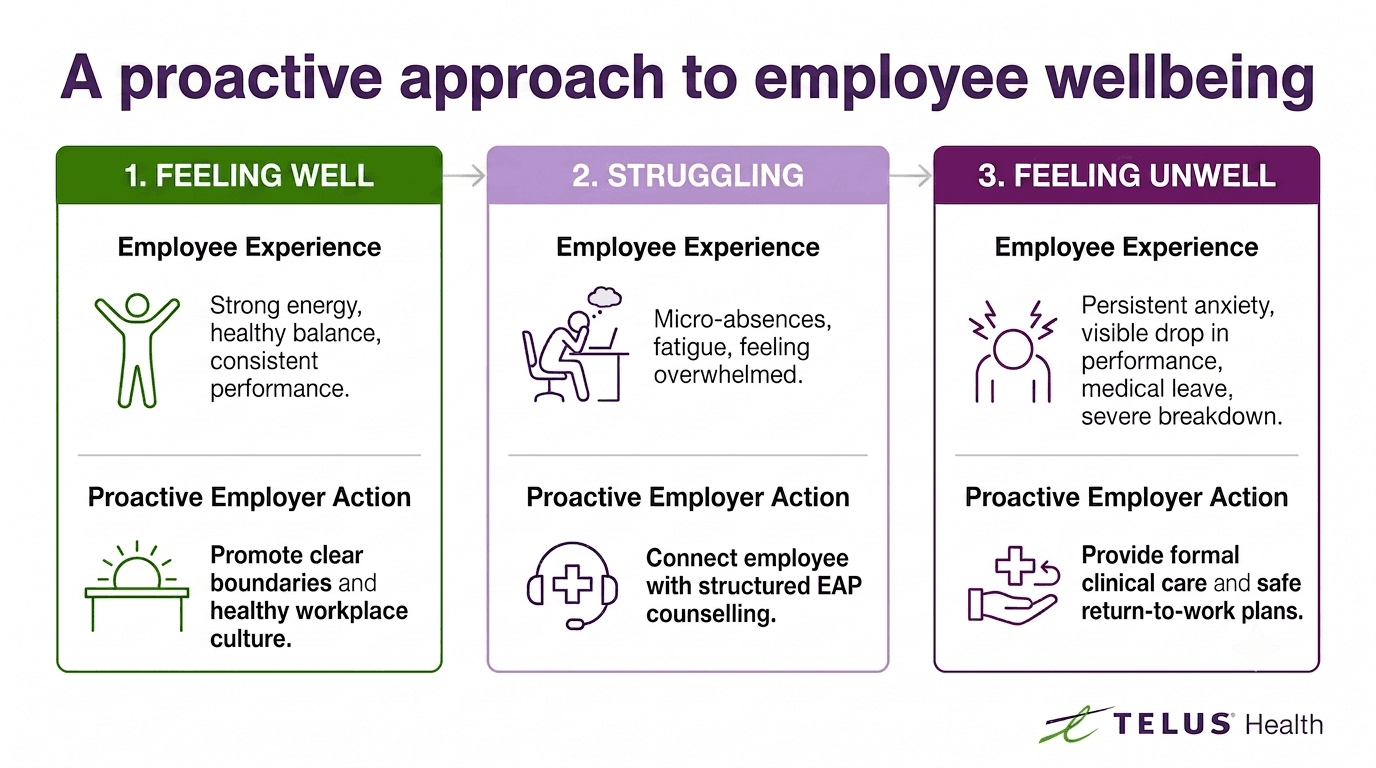
Wellbeing continuum
Waiting until an employee needs clinical intervention is expensive. Providing support at the struggling stage can help protect health and avoid costly claims.
Identifying mental health and burnout risks in your organisation
Sustainable high performance doesn’t mean pressing staff to work harder. Employers must create working conditions where energy can be renewed. Watch for these early warning signs:
- Shifts in absence pattern: Short-term sick leave increases, particularly stress-related absences.
- Spikes in after-hours activity: Late emails, weekend logins and "always-on" availability become the norm.
- Changes to feedback results: Survey comments or 1:1s reference overload, blurred boundaries and creeping fatigue.
- Accelerated turnover: Departures rise among high performers or newer colleagues who haven't built resilience yet.
- Increase in support resources: Use of employee assistance programmes (EAPs) or wellbeing services jumps — often the first sign of systemic strain.
Practical strategies to help reduce burnout
When organisations build systems for rest as deliberately as they build systems for results, the payoff can be measurable.
- Planned recovery cycles: Schedule low-intensity periods or task rotations after major business projects.
- Boundary setting: Encourage managers to delay late-night email sends and protect focus time.
- Outcome-based metrics: Measure performance by quality and business impact rather than hours worked.
- Shared responsibility: Normalise rest across teams to protect resilience.
Challenge 2: Measuring workplace wellbeing ROI
Participation data shows who used a benefit. Outcome data shows what actually changed in the business. Many HR teams still measure success by counting portal logins or event sign-ups. High-performing organisations now focus on measuring wellbeing ROI to prove business impact.
Moving beyond surface metrics
HR dashboards often focus on tool downloads rather than business performance. Senior leaders then question the financial return on health investments. According to guidelines from the Advisory, Conciliation and Arbitration Service (Acas), tracking workplace health metrics helps organisations identify problems early and manage costs.
The key is to distinguish between vanity metrics and outcome metrics in order to provide clear ROI targets for executive leadership. These metrics can include:
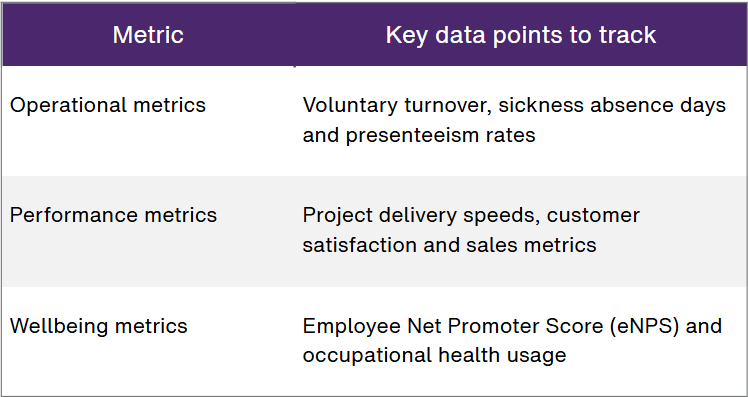
Measuring what matters
To prove impact, organisations need to connect wellbeing metrics to core business KPIs. People leaders can start by establishing baseline data, then track what changes over time. Your organisation likely has the data they need, they just need to know where to look. The most effective measures often include:
- Turnover and retention rates, especially among high performers
- Absenteeism and presenteeism days per employee
- Productivity indicators like sales per rep or project velocity
- Healthcare or benefits utilisation, identifying trends in physical and mental health claims
- Employee Net Promoter Score (eNPS) or engagement index
- Manager confidence scores around wellbeing support.
Most HR teams already track a wealth of information such as Human Resources Information System (HRIS) data, pulse surveys and participation reports. What's missing are the foundations for measuring wellbeing ROI: baseline measures before interventions, cost-of-absence data and segmentation by department or demographic. Regular feedback helps adapt wellbeing initiatives to changing employee needs. Without those, insights can remain too general to drive change.
The other missing piece is human context: stories and testimonials that show how wellbeing efforts changed lives or teams. Data opens the door; stories make people walk through it. Together, these create a quantifiable bridge between wellbeing activity and performance outcomes.
Challenge 3: Building a supportive employee wellbeing strategy and workplace culture
Company policies are only as effective as the daily workplace culture. Many UK businesses offer flexible working arrangements and mental health support. However, an employee wellbeing strategy works best as a holistic approach embedded in daily leadership behaviour, not as isolated policies. A holistic approach integrates mental health with physical, social and financial wellbeing.
When senior leaders reward long hours and late-night messages, employees hesitate to use policies designed for their benefit. Under UK health and safety regulations, employers have a legal duty to assess psychosocial risks in the workplace. Building a supportive culture can help manage these risks effectively and demonstrates compliance with the Health and Safety at Work etc. Act 1974.
According to the HSE, healthy workplace culture relies on consistent leadership actions. Acas guidance on employee health emphasises that cultural change requires visible executive commitment.
Actions that can help strengthen company culture
Culture rarely changes through grand initiatives. It evolves through consistent micro-signals that are showcased by the everyday choices leaders make, with supportive management acting as the day-to-day expression of culture. For example, you could look at implementing the following changes:
- Leadership agenda: Add employee wellbeing as a standing item in executive board meetings, with senior managers accountable for reviewing employee engagement and wellbeing progress.
- Outcome focus: Shift performance reviews from total hours logged to actual results achieved.
- Visible leadership: Encourage executives to model healthy behaviours, such as taking full lunch breaks and annual leave, while managers lead by setting clear expectations about healthy ways of working.
- Micro-habits: Introduce quiet focus hours and walking meetings into weekly schedules, and celebrate team successes to reinforce connection and belonging.
Addressing awareness gaps
The MHI shows that 34 per cent of workers in the UK believe their employer doesn’t offer an employee assistance programme (EAP), and another 31 per cent are unsure if one exists (September 2025). This means 65 per cent of the workforce lacks clear knowledge about available care. When organisations raise awareness, mental health scores can improve.
HR leaders must share information about support programmes during regular business updates, compensation reviews and team briefings. Simple, direct communications via multiple channels such as email, team huddles and physical posters, can reach different employee groups. Frontline workers and lower-earning staff are particularly likely to miss centralised email communications.
Challenge 4: Improving manager wellbeing support capabilities
Managers influence the daily work experience of their team members. Yet many managers report feeling unprepared when a direct report experiences a mental health issue. According to recent research, 40 per cent of people leaders lack training to address mental health concerns.
Policies set organisational intent, but without manager wellbeing support skills, interventions can stall at the point of action. Managers may avoid difficult conversations, miss early warning signs of distress or treat health issues purely as performance problems.
Under UK health and safety law, line managers are responsible for identifying and responding to psychosocial hazards including stress, mental health conditions and excessive workloads. Providing mental health awareness training for managers is both a legal duty and a business imperative. Trained managers are better placed to support employee wellbeing, support employees and guide them to appropriate support before minor stress escalates to absence or crisis.
Building manager capability
Building confidence isn’t about turning managers into medical professionals. It involves giving them the confidence to notice changes in behaviour, listen without judgment and direct staff to professional care while helping people connect to meaningful work. Research shows employees led by excellent managers are 6.5 times more likely to be fully engaged in their work, and employees with high career wellbeing are twice as likely to thrive in life.
Invest in practical training that can help leaders handle role clarity well:
- Recognise subtle changes in team behaviour and performance.
- Conduct safe, supportive conversations without acting as a therapist.
- Guide employees toward appropriate support options quickly, including helping people understand job roles and priorities to reduce unnecessary stress.
- Make reasonable workload adjustments based on identified strain, supporting fairer workloads and stronger job satisfaction.
Ways to build manager confidence
Confidence grows through practice and reinforcement, not policy memos, and a successful wellbeing strategy depends on managers having practical tools they can use day to day. The most effective approaches include:
- Scenario training: Use real-world roleplay exercises to practice sensitive conversations.
- Clear toolkits: Provide step-by-step guides detailing what to say, helping managers set clear expectations for conversations and escalation routes.
- Peer mentoring: Pair line managers with experienced leaders who have handled complex staff support situations.
- Clear referral paths: Maintain direct links to internal HR teams, clinical resources, employee assistance programs and counselling services.
Removing the stigma of disclosure and promoting work life balance
Almost half of workers in the UK (49 per cent) worry that disclosing a mental health condition will harm their career (June 2025). Trained managers can help build psychological safety. When employees trust their managers, they ask for help early, keeping minor stress from becoming a major absence issue.
Clear, repeated messaging about confidentiality matters. Employers can help solve this by highlighting that support services remain completely confidential and are provided by third-party specialists.
Workplace wellbeing isn't just a moral imperative — it's a strategic advantage. The organisations that thrive won't be those with the most policies. They'll be the ones where wellbeing is woven into how work gets done: where rest is structural, impact is measurable, culture is authentic and managers are confident.

The people equation: How human wellbeing can multiply business results
Learn why traditional approaches to employee wellbeing are evolving, and how connecting people with care proactively can help to drive measurable results.
Download the eBookFrequently asked questions
What are the main causes of workplace burnout in the UK?
Workplace burnout is primarily caused by unmanageable workloads, constant digital connectivity, poor work-life balance and unclear job expectations. Organisational factors like reward systems that encourage long working hours and presenteeism also contribute heavily to staff exhaustion. Burnout is not an individual failure—it stems from workplace systems that organisations can change.
How can UK employers legally manage mental health at work?
UK employers must treat mental health with the same importance as physical health under the Health and Safety at Work etc. Act 1974. The Health and Safety Executive (HSE) requires organisations to assess psychosocial risks, make reasonable adjustments and follow Acas guidelines for managing staff absence. Organisations must document risk mitigation strategies and show evidence of proactive support.
What is the role of line managers in employee wellbeing?
Line managers act as the primary point of contact for day-to-day health support. They’re responsible for spotting early signs of distress, conducting supportive check-ins, adjusting workloads where necessary and signposting staff to professional occupational health services. Trained managers should be able to recognise and intervene early rather than waiting until clinical intervention is needed.
How does an EAP fit into a proactive workplace wellbeing strategy?
An employee assistance programme (EAP) serves as an early intervention tool . It provides fast access to professional counselling and resources before minor work stress leads to medical leave or long-term sick absence. EAPs work best when staff are aware they exist and understand how to access them confidentially.