
Key takeaways
- Stigma is stuck. 60 per cent of workers in the UK say their workplace culture is supportive, yet mental health self-stigma in the UK hasn't improved.
- The most at-risk groups fear judgment most. Parents and workers under 40 are 50 per cent more likely to worry that others will think differently of them if they seek support.
- Access is the hidden barrier. 37 per cent of workers in the UK cite cost and 56 per cent cite long wait times as the main reasons they don't get mental health support.
- Inaction has a price. Workers who want better mental health support lose 49.9 days of productivity each year.
- The fix is a three-step approach. Build cultural permission, make access simple and free, then engage employees in proactive care before problems escalate.
A global perspective on mental health challenges and solutions
Many employers understand the importance of employee mental health, and 60 per cent of workers say their workplace culture feels supportive, yet stigma remains one of the biggest barriers. For organisational leaders, managers and employees trying to improve support at work, that gap matters: it affects whether people speak up, get help and stay well enough to do their jobs. Despite years of wellness initiatives and awareness campaigns, the TELUS Mental Health Index (MHI) confirms that mental health stigma continues to affect employees worldwide (January 2025). It shapes career decisions, self-perception, overall wellbeing and, in turn, productivity and the future leadership pipeline.
There's a second problem that gets less attention. Reducing stigma gives employees permission to speak up, but permission alone doesn't lead to care. According to the MHI, 37 per cent of workers in the UK cite cost as their main barrier to mental health support and 56 per cent point to long wait times. Awareness without access leaves people stuck, especially groups already under pressure, including parents, younger workers and managers.
This article looks at where workplace stigma persists, why many managers still feel unprepared, how gaps in awareness and wellbeing programmes limit support, and what UK employers can do to help reduce stigma, improve access and treat mental health as equally important as physical health.
How stigma manifests globally
Our MHI analysis of over 19,000 employed adults across 12 countries reveals that while mental health stigma in the workplace manifests differently across cultures, it shares common threads that impact employees universally. From North America to Asia and Europe, the data shows concerning patterns that demand immediate attention.
The majority of workers express concerns about disclosing mental health issues in the workplace due to potential career consequences. These concerns are significantly more pronounced among workers under 40, highlighting the impact on emerging talent and the future leadership pipeline. In addition to career fears, younger employees are also more likely to feel negatively about themselves for experiencing mental health challenges, creating additional barriers to seeking support (January 2025). This is a clear indication of the power of the workplace context, how younger workers perceive stigma at work, which might differ from other areas in life, and how that experience at work impacts them.
Mental health at work statistics: The UK picture
The UK numbers show how high the stakes are. The HSE defines stress as an adverse reaction to excessive pressure. Our Mental Health Index found that parents and workers under 40 are 50 per cent more likely to worry that others will think differently of them if they seek mental health support. Managers are 40 per cent more likely than non-managers to share that worry. The cost of staying silent is steep. Workers who want better mental health support lose the equivalent of 49.9 working days of productivity each year, 25 more days than workers who don't need additional support, and those lost days are commonly linked to work related stress, depression and anxiety.
Slow progress on reducing mental health stigma in the workplace
Have we progressed in recent years? The answer, unfortunately, is "not significantly". Findings in Canada, the UK, the U.S. and Australia suggest that mental health self-stigma has shown minimal improvement. In Canada and Australia stigma levels have barely improved, while the UK has seen no change and the U.S. has actually experienced a decline despite widespread corporate and societal awareness efforts.
The UK gap is striking. According to the MHI, 60 per cent of UK workers describe their workplace culture as supportive. Yet self-stigma hasn't moved. A supportive feeling is a starting point, but it doesn't give employees the confidence or the pathway to seek care.
Unprepared leadership: The training gap
The challenge extends beyond employee stigma. A significant number of managers report they are unequipped to help employees deal with mental health issues in the workplace. Across countries, many leaders admit that they lack the knowledge and skills to respond when mental health challenges arise in their teams (June 2025).
This gap matters even more in the UK, where employers have legal responsibilities to assess and reduce workplace stress risks, including conducting mental health risk assessments. The Health and Safety Executive's management standards set out what good practice looks like. Regularly assessing workplace stress and addressing its causes is best practice, not a one-off exercise. Under the Equality Act 2010, some mental health conditions may amount to a disability, which can trigger legal duties. Targeted training and development can give line managers practical skills for managing facing mental health challenges. That includes holding supportive one-on-one conversations, responding to disclosures with empathy and connecting people to professional support without overstepping boundaries.
Workers lack mental wellbeing programme awareness
Additionally, a substantial number of workers report that communication regarding their organisation's health and wellbeing programmes is unclear or inconsistent. This communication gap highlights the need to reassess outreach strategies to ensure both employees and their managers are aware of available mental health resources and support services.
The MHI shows how wide this gap is in the UK: 20 per cent of workers don't know where to get mental health care and 25 per cent would be uncomfortable sharing that they need support at all (January 2025). Even though 75 per cent of organizations offer mental health support services, awareness still breaks down when communication is poor. These employees may have permission to speak up, but they hit a wall the moment they try to act. Closing this gap is one of the biggest employee wellbeing challenges facing employers in the UK.
The path forward: strategic solutions for employers
As an organisational leader, manager or employee, you have the opportunity to help combat mental health stigma in your workplace by acting on it. Employers should support mental health with the same seriousness as physical health. The time for change is now, and it starts with each of us, in every conversation, every policy decision and every moment we choose empathy over judgment.
Breaking the silence is step one. The next step is making sure every conversation leads somewhere. A simple three-step approach connects cultural permission to real care:
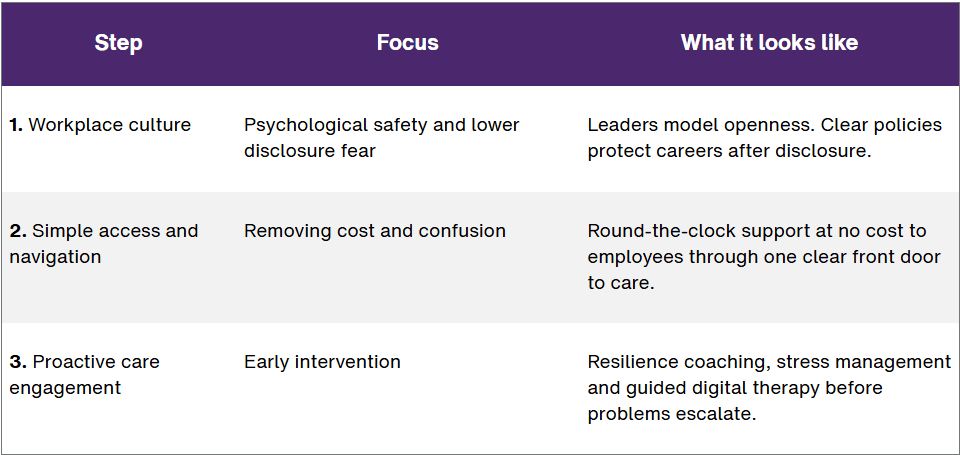
Step 1 builds psychological safety in the workplace so employees no longer fear career damage when they speak up. Any workplace mental health approach should also address excessive workloads, inadequate staffing, poor management and unclear role responsibilities, which HSE guidance recognises as drivers of chronic workplace anxiety. Step 2 answers the question every employee asks next: "I spoke up, now what?" This is where the quality of your EAP matters. Step 3 keeps small struggles from becoming sickness absence. Integrated employee health and wellbeing solutions bring all three steps together in one place, so employees always know where to turn.
Employers that get this right can expect results they can measure: higher support engagement, faster time to care and fewer days lost to sickness absence. Our employee wellbeing trends research shows that proactive, preventative support is what separates leading UK employers from the rest.

Take the next step
Your employees are ready to talk. Discover how employee health and wellbeing solutions from TELUS Health connect your people to confidential, round-the-clock care at no cost to them.
Learn moreFrequently asked questions
Why isn't reducing stigma enough to improve mental health in the workplace?
Reducing stigma encourages employees to speak up, but UK data from the TELUS Mental Health Index shows that 37 per cent of workers face cost barriers to care and 56 per cent face long wait times. Without clear, affordable pathways to support, stigma reduction creates demand that employees can't act on.
How do you manage stress in the workplace?
Effective stress management combines workplace adjustments, such as workload reviews, role clarity and flexible schedules, with manager training. When managers can spot early signs of burnout, organisations can step in before stress leads to long-term sickness absence.
What are the best strategies for managing employees with mental health issues?
Managers should focus on empathetic, structured communication. That means agreeing on reasonable adjustments where a mental health condition may qualify as a disability under the Equality Act 2010, and connecting the employee directly to confidential professional support. Managers should lead with support rather than diagnosis, keeping the focus on enablement and psychological safety. Unlawful discrimination must be avoided when supporting any person with mental health conditions at work.
What role does managing mental health in the workplace play for line leaders?
Training bridges the gap between executive policy and daily team experience. It gives line managers the confidence and practical skills to hold supportive one-to-one conversations, respond well to mental health disclosures and direct employees to the right care without overstepping boundaries.
How can UK employers overcome the cost and wait-time barriers to mental health care?
Employers are legally obliged under employment law to provide appropriate support and maintain compliance when helping staff access care, including through a fully funded employee assistance programme (EAP) and digital mental health tools. This duty includes mental health, not just physical health. These give employees immediate, confidential access to counselling, self-guided therapy and preventative wellbeing resources at no cost to them, alongside self care tools that help them cope and manage their own mental health between formal support sessions. Employees should seek advice early, as not everyone will show obvious signs of poor mental health.

Jenna Avella
Copywriter & Senior Marketing Manager at TELUS Health
About the author
Jenna Avella is a Senior Marketing Manager at TELUS Health, specializing in data-driven health and wellness communications designed to help empower organizations and their workforce. With over a decade of professional editorial experience across high-growth health, lifestyle, culture and tech, she brings deep expertise in converting complex health concepts into actionable workplace solutions—from employee assistance programs (EAP) to total wellbeing strategies. Jenna is a graduate from McMaster University and has established a robust track record writing authority-building content for industry-leading health platforms. Her writing focuses on employee wellbeing and mental health and organizational wellness, driving thought leadership across TELUS Health's resource ecosystem.