

Employee wellbeing is now a board-level issue, but most strategies aren't built to scale
Mental health used to sit with HR alone. Now it shows up in board meetings, investor updates and workforce planning conversations. Leaders are asking a bigger question than "do we have an employee assistance programme." They're thinking about whether their organisation's approach to mental health can hold up across ten offices and five time zones, with a workforce that keeps growing and is distributed.
That's not always an easy question to answer and that uncertainty carries a cost. According to the World Health Organization, an estimated 12 billion working days are lost globally each year to depression and anxiety, at a cost of $1 trillion in lost productivity. When support is strong in one region and thin in another, some of that loss quietly lands on employers who assumed they already had it covered.
The new mental health mandate for HR leaders
Traditional mental health support was built to react. Someone reaches a crisis point, then support kicks in. That model made sense when mental health sat outside the scope of workforce strategy, but it doesn't hold up as well today.
Investing in employee wellbeing tends to pay off in measurable performance, not just healthier teams. The McKinsey Health Institute estimates investing in holistic employee health could generate up to $11.7 trillion in global economic value. That's the scale leaders are increasingly expected to think at, and it's part of why mental health strategy is moving from an HR line item toward a board-level agenda point.
For most organisations, the real mandate is to build a system that works everywhere the organisation operates, not only in the regions where the strategy first started.
What is a blended mental health strategy?
A blended mental health strategy combines proactive prevention, like manager training and self-guided tools, with reactive response, like counselling and crisis care.
Think about physical health for a moment. Organisations invest in prevention, things like fitness programmes and ergonomic setups, and they still need urgent care when something goes wrong. Mental health tends to work the same way. Prevention builds resilience over time. Response gives people somewhere to turn when they need it most. Leaning on only one of the two tends to leave real gaps in care.
The cost of a fragmented approach
Fragmented support tends to fail quietly. Employees often don't know what's available to them, or they don't trust it enough to use it.
TELUS Health's own Mental Health Index for the United Kingdom found that 34 per cent of workers say their employer doesn't offer an employee assistance program, and a further 31 per cent are unsure. That works out to nearly two-thirds of a workforce who either can't access support or don't know it exists, and awareness gaps like this can quietly erode the return on every wellbeing dollar spent.
The same report found only six in 10 UK workers believe their organisation's culture supports their personal wellbeing. That gap tends to show up directly in performance too. Workers who feel supported score more than 19 points higher on the Mental Health Index than those who don't, and they lose 24 fewer working days a year to reduced productivity.
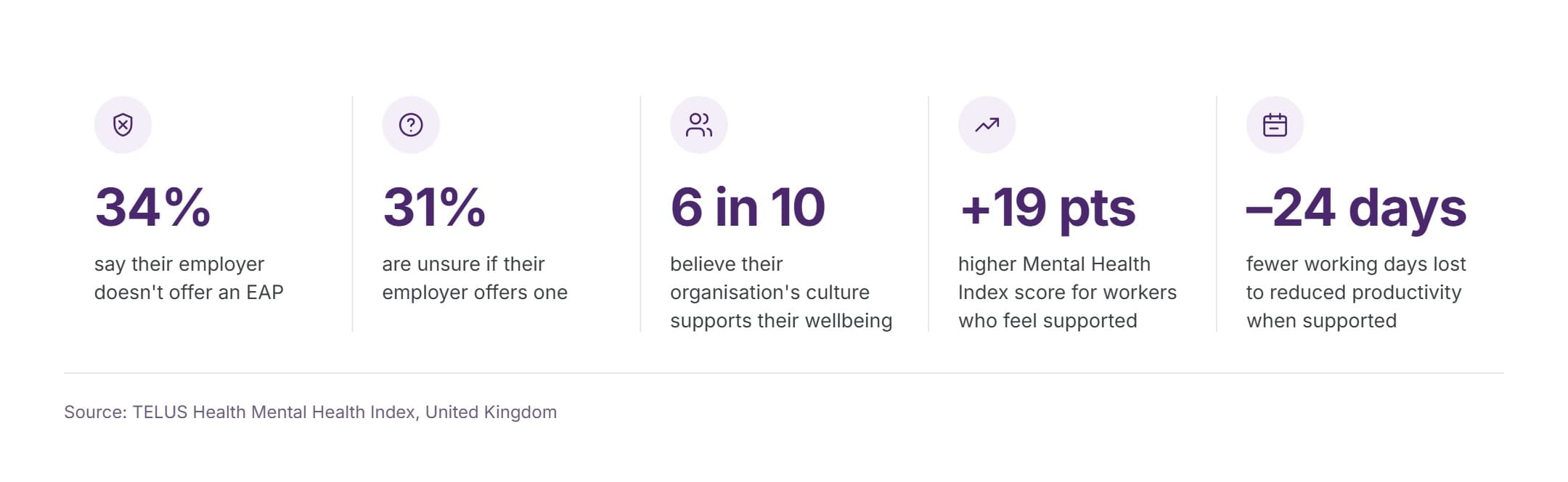
Source: TELUS Mental Health Index, UK
Deloitte's research points to a similar pattern globally. Even as employer-provided mental health resources grow year over year, only around four in 10 employees who report feeling stressed or anxious most of the time actually use their EAP. More often than not, the real barrier is trust and visibility rather than availability alone.
That's the cost of fragmentation in practice. Support that exists on paper but isn't embedded into daily work tends to go unused, and unused support rarely delivers much of a return.
Building a scalable wellbeing ecosystem
A wellbeing ecosystem meets employees where they are and adapts as the organisation grows. That means combining digital tools with human care, and building a stepped care model that gives people the right level of support at the right moment, from self-guided resources through coaching to clinical care.
A few things separate a scalable ecosystem from a patchwork of services:
- A data-informed strategy: Uptake, engagement and outcomes get measured, not assumed.
- Global consistency balanced local nuance: A single framework applies everywhere, but delivery adapts to language, culture and stigma in each region.
- Clear governance: Ownership and accountability sit at every level, not just within HR.
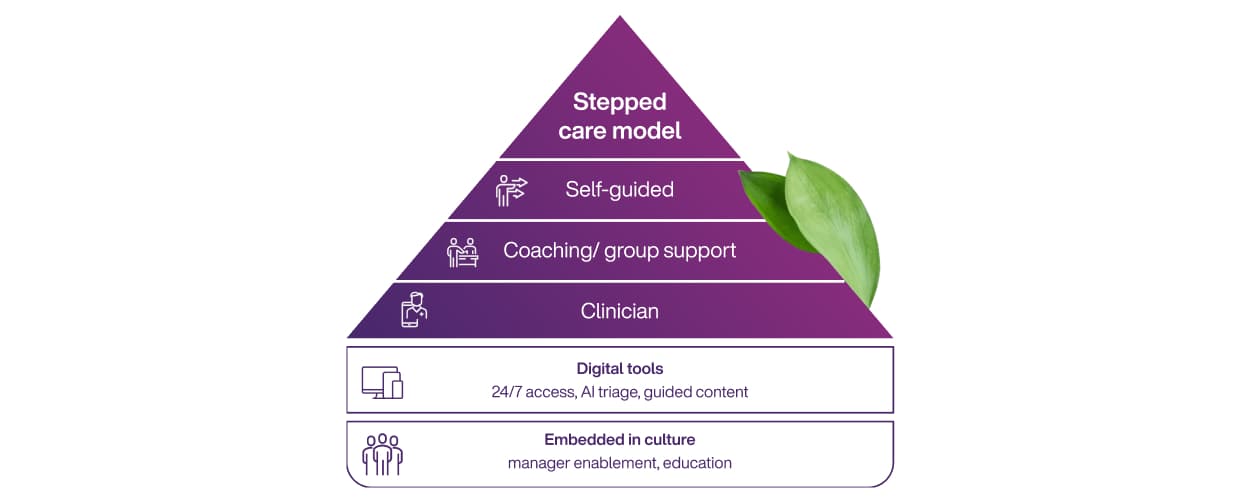
The 5Rs framework for a repeatable mental health strategy
Stress-test any wellbeing strategy against these five questions before scaling it. The 5Rs framework gives HR and benefits teams a structured way to do that.
- Reach: Is the support visible and accessible across the whole population?
- Relevance: Does it match real employee needs and cultural expectations?
- Responsiveness: Can people get timely support when they need it?
- Results: Are outcomes being measured, not just usage?
- Repeatability: Can the approach scale across regions and demographics?
Most wellbeing programmes can answer the first two or three questions comfortably. Fewer can answer all five, and that's often where scaling starts to run into trouble. A programme that reaches employees in one region but struggles to repeat that reach elsewhere tends to stay a pilot rather than grow into a strategy.
Designing for inclusion across a global workforce
A strategy that works well for one part of the workforce and misses the rest isn't truly scalable, even if it performs well on paper.
Inclusive wellbeing programmes tends to start with access through:
- Language support
- Digital accessibility
- Solutions that account for different time zones and working patterns.
Inclusive wellbeing programmes also means designing for neurodiversity, gender-specific health needs and the realities of frontline or hourly workers who don't sit at a desk all day.
When support is built to be inclusive from the outset, it tends to reach more people and earn more trust than support retrofitted later to cover the gaps.
Stigma is part of this picture too, and it doesn't always look the same from one place to another. TELUS Health's own research on workplace mental health stigma found that stigma shows up differently across cultures but affects employees' willingness to seek help in most of the markets studied. A global strategy generally needs to account for that variation directly, rather than assuming a single awareness campaign will land the same way everywhere. Local champions, localised language and manager training tailored to each region's norms tend to do more to close this gap than one global message ever could on its own.
Why proactive support matters as much as crisis response
It's easy to think of an EAP mainly as the safety net you reach for once things go wrong. That framing tends to undersell what proactive support can actually do. As TELUS Health outlines in Why EAPs aren't just for crises, the same programmes built for crisis intervention also include coaching, financial guidance, manager consultations and everyday wellbeing tools that employees can use long before a crisis hits.
Treating an EAP purely as crisis infrastructure means a lot of its value can go untapped. The organisations getting the most from their wellbeing spend tend to treat prevention and response as one continuous system, rather than two separate budget lines.
This shows up in how EAPs actually work in practice too. As TELUS Health explores in More than a wellbeing programme: How EAPs can create lasting change, support tends to work best when it's built around a wellbeing continuum rather than a single crisis moment, meeting employees wherever they sit between thriving, struggling and unwell.
TELUS Health's own Mental Health Index found that EAP awareness alone tends to lift mental health scores by two points in the UK and 1.5 points in the US, a reminder that a programme only creates lasting change when people actually know it's there and understand how to use it.
Choosing the right wellbeing partner to execute the strategy
A strategy tends to be only as strong as the partner delivering it. HR leaders often tell us they feel overwhelmed by point solutions, one more app and one more login to manage. The right partner can help connect the dots, rather than adding another disconnected tool to the pile.
Before signing with a wellbeing vendor, ask these five questions:
- Global reach with local nuance: Can they support every region the organisation operates in, while adapting to local culture and stigma?
- Early intervention capability: Does the platform help identify risk before it becomes a crisis?
- Integration: Does it connect with existing systems like the EAP, learning platforms and leadership training?
- Measurable outcomes: Can they report on impact, not just usage numbers?
- Clinical governance and data privacy: Are there clear standards for confidentiality and care quality?
The difference between a vendor and a partner usually comes down to these criteria.
Wellbeing vendor
- Delivers a single service or app
- Reports usage numbers
- Applies one model across every region
- Onboards and steps back
Wellbeing partner
- Connects prevention, response and reporting into one strategy
- Reports outcomes and impact
- Adapts delivery to local culture and language
- Stays involved as the organisation and its needs change
How TELUS Health supports organisations scaling mental health globally
TELUS Health combines digital wellbeing tools with local, confidential mental health support built to scale across regions. Our suite of Health and Wellbeing Solutions support your workforce to adapt, recover and grow.
TELUS Health Engage brings daily wellbeing content, personalised challenges and 24/7 clinical support together in one platform, so employees get a tool they'll actually use and HR teams get a programme they can measure.
TELUS Health One unifies our clinician-led EAP with proactive mental health tools in a single, accessible platform. The platform offers Digital mental health tools with clinical depth and global consistency.
Building a mental health strategy that scales
A scalable mental health strategy blends prevention with response, adapts to local context without losing consistency and gets measured against outcomes, not just usage. It's a strategy question first, and a vendor question second.
Organisations that get this right build a workforce that can weather change, wherever in the world that workforce sits.
FAQ
What does it mean to scale mental health support globally?
It means building one consistent framework, blending prevention and response, that adapts to local language, culture and regulation across every region an organisation operates in.
What's the difference between a proactive and reactive mental health strategy?
Proactive support builds resilience before problems arise, through training and self-guided tools. Reactive support responds once a crisis or need has already emerged.
How do I know if our wellbeing programme is actually working?
Measure outcomes like mental health scores, productivity loss and programme uptake, not just how many employees have access to the benefit.
What should I look for in a wellbeing partner?
Look for global reach with local nuance, early intervention capability, integration with existing systems, measurable outcomes and strong clinical governance.
Why do employees underuse mental health benefits that are already available?
Often it comes down to awareness and trust, not access. Employees may not know a benefit exists, or may not trust it enough to use it.