
Key findings
- 37 per cent of employees in the UK cite cost as the biggest barrier preventing them from accessing mental health support.
- Employees who face no barriers to care lose approximately 35 fewer working days per year than those facing the greatest barriers.
- Affordability is the biggest barrier preventing employees from seeking support, leading by 10 percentage points.
- Employees with unrestricted access to support report significantly stronger mental health outcomes, including a Mental Health Index score nearly 13 points higher than the national average.
Cost remains the greatest barrier to mental health support. Removing it could be one of the highest-impact investments employers can make.
Access to mental health support means little if the people who need it most can’t afford to use it.
Our latest Mental Health Index (MHI) found that this is very much the case, with 37 per cent of employees in the UK citing cost as the biggest barrier preventing them from accessing mental health support (MHI, Q1 2026).
This barrier can have a measurable impact on employee wellbeing, workplace performance and the bottom line. For example, workers who cite affordability as a barrier are losing 20.5 more working days per year than those who report no barriers to care, while employees with unrestricted access to support report a significantly stronger MHI score, nearly 13 points higher than the national average (MHI, Q1 2026).
For HR and benefits leaders, these findings should serve as a wake-up call. Mental health benefits only deliver value when employees can access them, and it’s up to leadership teams to reduce financial barriers by providing accessible, employer-funded mental health support. This can help to bolster employee wellbeing, as well as strengthen workplace productivity and support in building a more resilient workforce.
Here’s why affordability continues to be the biggest barrier to mental health support and what employers can do to improve access to care.
Making the case for mental health support in the workplace
Nearly six years after the launch of the Mental Health Index in April 2020, the proportion of workers
in the “high-risk” group for mental wellbeing has declined by only seven per cent (MHI, Q1 2026). This trend suggests that many employees are still struggling to access the support they need, underscoring the importance of investing in benefits programmes that actively remove barriers to care.
The advantages of doing so extend far beyond the individual employee:
- One Deloitte UK study found that for every £1 GBP spent on supporting mental health and wellbeing, employers receive approximately £4.70 back in increased productivity.
- The same Deloitte study found that organisation-wide early interventions, such as culture change and raising awareness of mental health issues provide the highest ROI, averaging £6.3 for every £1 invested.
- According to TELUS Mental Health Index data, employees with no barriers to mental health support lose an average of 23.2 working days per year, whereas those with no energy to seek care lose upwards of 58.4 working days per year.
Without a doubt, employees (and therefore, organisations) are most successful when individuals have convenient access to the mental health support they need. Yet for many workers, accessing care is easier said than done, and they continue to face barriers that prevent them from seeking care when they need it most.
Why affordability is the biggest barrier to mental health support
Thirty-seven per cent of workers in the UK cite cost as the biggest barrier preventing them from accessing mental health support. What we haven’t mentioned is that this barrier leads the category by 10 percentage points (MHI, Q1 2026).
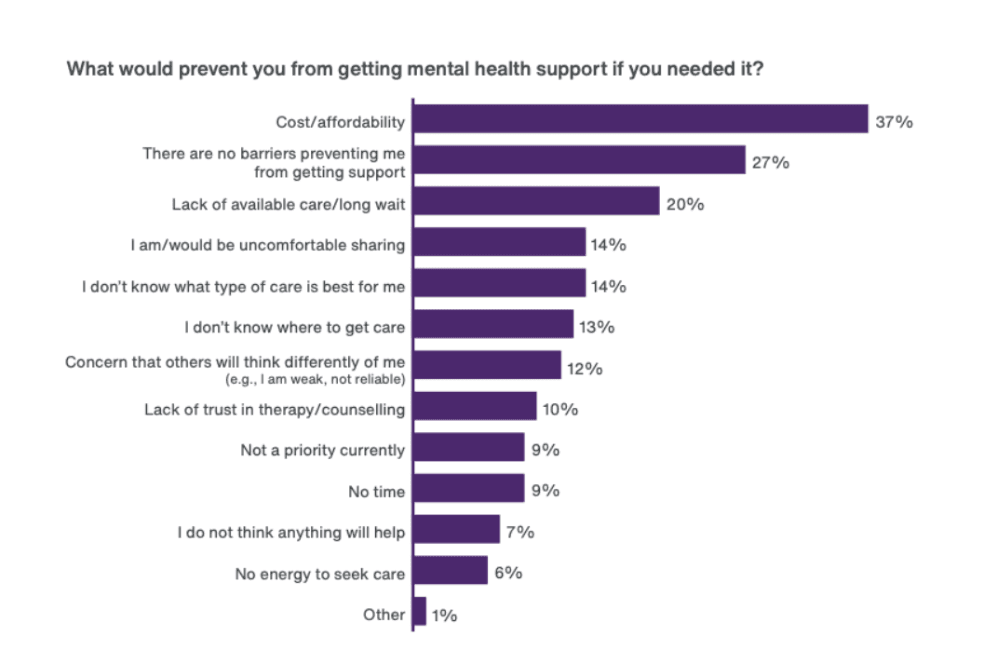
TELUS Mental Health Index UK (Q1 - 2026)
It’s important to note that some groups face greater barriers accessing care than others. For example, workers over 50 are nearly twice as likely to report no barriers to accessing care, while parents face more barriers than non-parents (MHI, Q1 2026).
To complicate matters, access to mental health support becomes even more convoluted when affordability intersects with other challenges. For example, recent analysis of NHS data by Rethink Mental Illness suggests eight times as many people are still waiting for mental health treatment after 18 months compared to physical health care.
For employees already concerned about the cost of mental health support, delays like these can make seeking support feel even more daunting. And for employers, offering benefits alone is no longer enough. You must also make them affordable and accessible to employees when they most need them.
The mental health support gap is about more than cost
Affordability may be the biggest barrier to mental health support, but it is far from the only one. In many cases, employees face multiple obstacles at the same time, which creates a compounding effect that makes accessing care even more difficult.
One such challenge is stigma. According to Mental Health Index data, 14 per cent of workers say they would be uncomfortable sharing their mental health concerns, while managers, parents and workers under 40 are more likely to worry that others will think differently of them if they seek support (MHI, Q1 2026).
The Q1 2026 MHI found that parents and workers under 40 are 50 per cent more likely to be concerned that others will think differently of them if they seek mental health support.
For employees already weighing up the financial cost of care, these social concerns can create yet another reason to delay seeking help.
Perhaps the most concerning finding is that six per cent of workers report lacking the energy to seek care altogether (MHI, Q1 2026). This group reports the lowest Mental Health Index score of any barrier category and experiences the greatest productivity loss (MHI, Q1 2026). By the time employees reach this stage, navigating benefits programmes, researching providers and booking appointments can feel like a near-impossible task.
The takeaway is that no single solution will close the mental health support gap. Instead, it’s important to take a multifaceted approach to mental health care, ensuring you combine affordable options, clear communication, relevant training and accessible support to help employees overcome barriers at every stage of their mental health journey.
How employers can remove barriers to mental health support
The good news is that the mental health support gap is not an unsolvable problem. More importantly, solving it will improve organisational performance. For example, workers who report no barriers to mental health support have mental health scores nearly 13 points higher than the national average and lose approximately 35 fewer working days per year than employees with no energy to seek care (MHI, Q1 2026).
The question, then, is not whether employers should invest in mental health support, but how.
-
Design mental health benefits with accessibility in mind
The first step is ensuring that mental health benefits are easy to access. This means removing barriers to care and giving employees multiple ways to find support when they need it.
This may include:
- 24/7 access: It goes without saying, but mental health challenges don’t always arise during business hours. Around-the-clock access can help employees to seek support when they need it most.
- Flexible pathways to support: Employees have different preferences when it comes to seeking support. Offering digital, phone and in-person care options — alongside always-on and AI-enabled support tools — can help people access care in a way that feels most comfortable and convenient for them.
- Support that reflects the diverse needs of employees: Mental health support is about so much more than just counselling. Resources for caregiving, work-life challenges, coaching and financial planning give employees the opportunity to access support that’s unique to their own personal circumstances.
Finally, make sure that employees know these benefits are available at no cost to them. When support is free (and freely available), individuals are more likely to seek help at an earlier stage into their healthcare journey.
That’s where employer-sponsored resources like an employee assistance programme (EAP) can help. EAPs actively remove the financial barriers that stop employees accessing care. They also offer timely and confidential support when (and where) employees need it most.
2. Create a culture where employees feel safe seeking support
Next, cater to the implications that come with offering mental health support. Reducing stigma around accessing support, for example, can influence whether employees feel comfortable even seeking it in the first place.
Manager training can help leaders identify employees who may be struggling, while visible leadership support can normalise conversations about mental health and encourage earlier intervention.
“Education and awareness equips leaders with being able to look for the signs and symptoms of people that are struggling. The more tools we can give to leaders to support this, the more we can increase peoples’ confidence.”
- Sandy McIntosh, Executive Vice-president, People & Culture and Chief Human Resources Officer, TELUS
3. Make support easier to find and use
Finally, recognise that even the most comprehensive benefits programme will be limited if employees do not understand what support is available or how to access it. It’s therefore important to focus on targeted communication campaigns and outreach, especially to higher-risk groups, as this can help ensure employees receive personalised and proactive support.
“A lot of people don’t trust counseling, and a lot of people don’t trust their employer. Communication has to directly address those fears.”
- Luc Bourgeois, Director, Communication & Change Management Solutions, TELUS Health
Turn your mental health investments into business outcomes
When all is said and done, the latest Mental Health Index data reveals a measurable link between access to care, productivity and organisational performance. And given that 37 per cent of workers identify cost as the primary barrier to accessing care, the resulting productivity loss should come as no surprise.
For employers, then, reducing barriers to support is an opportunity to maximise the impact of an investment in employee mental health through improved productivity and strengthened workforce resilience. One way to achieve this is to conduct a barrier audit to identify the financial, logistical and cultural obstacles preventing employees from seeking care.
Ultimately, investing in mental health is investing in organisational performance, and the employees who struggle to access support today may be among your most productive contributors tomorrow, but only if the barriers standing in their way are removed.
Increase access to mental health support with TELUS Health
TELUS Health helps employers improve access to mental health care through employee assistance programmes, counselling services, digital mental health tools and personalised wellbeing resources. Our solutions help organisations create healthier and more productive workforces.
Explore our suite of mental health solutions
Get the latest and greatest in employee wellbeing research
Receive Mental Health Index reports from TELUS Health and gain access to data-driven insights on employee mental health.
Subscribe todayFrequently Asked Questions
Mental health support remains a growing priority for employers, but many organisations still have questions about access, affordability and the role benefits play in supporting employee wellbeing. Here are answers to some of the most common questions about reducing barriers to care in the workplace.
Why is affordability the biggest barrier to mental health support?
According to the Q1 2026 Mental Health Index, 37 per cent of employees in the UK cite cost as the biggest barrier preventing them from accessing mental health support. Affordability prevents employees from seeking care more than any other barrier, including stigma, time constraints or provider availability.
How does access to mental health support affect workplace productivity?
Employees who can access mental health support without barriers report stronger mental health outcomes and significantly higher productivity. The latest Mental Health Index found that workers with no barriers to care lose approximately 25 fewer working days per year than those reporting no energy to seek care.
Which employees face the greatest barriers to mental health support?
The Mental Health Index found that managers, parents and workers under 40 are more likely to experience stigma. Workers over 50 are nearly twice as likely to report no barriers to accessing mental health support.
What can employers do to improve access to mental health care?
Organisations can improve access by offering comprehensive mental health coverage, robust employee assistance programmes (EAPs), preventive wellbeing resources and multiple pathways to care. Reducing stigma, simplifying access to support and improving communication about available resources can also help remove barriers.
How can employers measure the ROI of mental health benefits?
Employers can evaluate the impact of mental health investments by tracking metrics such as productivity, absenteeism, disability claims, employee engagement and benefit utilisation. Mental Health Index data suggests that reducing barriers to care can lead to measurable improvements in both employee wellbeing and organisational performance.