

Key takeaways
- Most employees still see their EAP as a crisis-only service. That perception gap keeps them from support that could stop problems early.
- UK sickness absence now averages 9.4 days per employee per year according to the CIPD, and mental ill health is the top cause of long-term absence.
- Modern EAPs cover everyday needs like financial guidance, legal advice, coaching and caregiver support, not just counselling.
- The biggest impact comes from reaching people in the “struggling” phase, before everyday stress becomes a crisis or a long-term absence.
- Communication and manager enablement drive EAP use. According to the TELUS Mental Health Index, 31 per cent of employees in the UK aren't sure their employer even offers one.
Employee assistance programmes, or EAPs, began as a way to help workers who were struggling. They first gained popularity at the tail end of the Great Depression as an extension of substance abuse programmes like Alcoholics Anonymous. In the decades that followed, these offerings grew to include other support, like financial and legal aid. But EAPs were traditionally designed to be reactive. They were an extra safety net for employees going through a crisis.
So it's no wonder that employees still tend to think of them as something other people need. That's the crisis management EAP mindset, and it comes at a cost. According to the Q1 2026 TELUS Mental Health Index (MHI), around one third of workers in the UK face a high mental health risk, yet many won't reach out for support until they hit a breaking point.
In recent years, EAPs have grown into something much more holistic. They now work as preventative and maintenance systems for even the healthiest and most engaged employees. So how can you find an EAP that employees will actually use, not just call when there's a crisis? Read on to learn how a modern employee assistance programme can support wellbeing and keep your teams happy and productive.
Why employees and employers need EAPs for mental health
Employers are finding that offering health insurance alone can't ensure employees' holistic wellbeing. The absence data tells the story, and businesses need broader employee health and wellbeing solutions and emergency support strategies, not just insurance.
The hidden costs of presenteeism in the UK workforce
According to the CIPD, UK sickness absence has reached an average of 9.4 days per employee per year, the highest level in over a decade. The same research found mental ill health is the top cause of long-term absence, cited by 41 per cent of organisations.
Presenteeism can cost even more. It describes employees who keep working while mentally or physically unwell. Someone dealing with chronic stress, caring for a relative or worrying about money rarely dials a helpline. They keep going at reduced capacity until the pressure turns into a long-term absence. It's one of the top wellbeing risk factors facing UK employees.
Engagement is suffering too. Gallup's State of the Global Workplace report found global employee engagement fell to 21 per cent, with lost productivity costing the world's economy $438 billion USD.
Modern EAPs are designed to tackle these issues with resources that can help support employees wherever they are on the wellbeing continuum. When employees can access support at any time, they're more resilient. That resilience has a real impact on an organisation's long-term success.
How EAPs offer more than damage control
But what does support from an EAP actually include? Certainly, it includes the employee counselling service and workplace therapy people usually think of when they hear the term “EAP”. Beyond these traditional offerings, today's EAP also covers support for caregivers, financial services, legal advice, learning resources and a proactive approach to physical wellbeing.
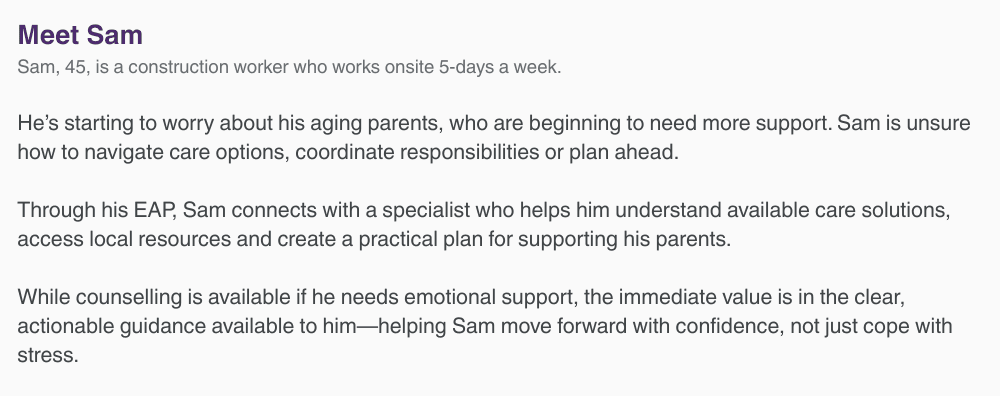
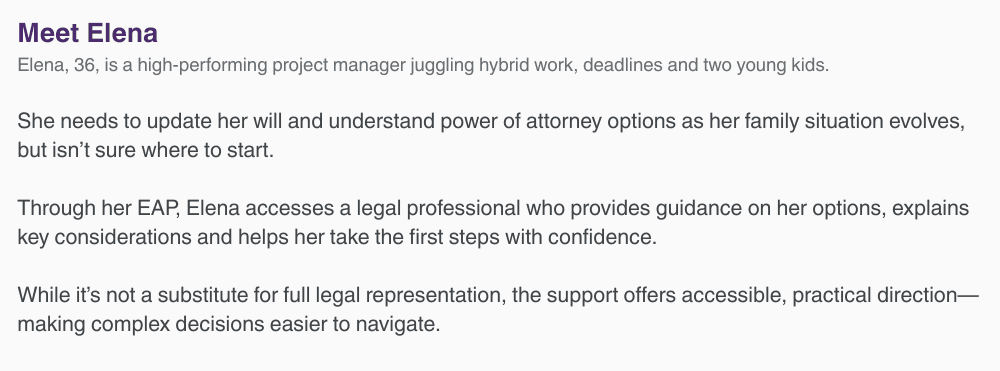
Modern EAPs also offer proactive tools like training and coaching, wellbeing assessments and activity tracking to support employees before challenges arise. EAP counsellors aren't only there for emergencies. They also support everyday concerns, for example:
- Lack of sleep support
- Financial and estate planning
- Help navigating family dynamics and pressures
- Rapid-response grief counseling
EAPs can also support mental wellbeing by helping people address mental health issues and providing referrals to long-term therapy or specialized medical care when needed. More than assisting employees in crisis, an EAP can help employees who already feel well stay that way.
“As a clinician, I've seen people flourish when they have unlimited access to personalised support like they do with the right EAP,” said Dr. Matthew Chow, Chief Mental Health Officer, TELUS Health. “Programmes that support employees, whether they're feeling well, struggling or feeling unwell, can make all the difference for employers who want their employees happy, healthy and thriving. The cost of not offering support like this can have a cascading impact on performance, for both employees and the organisation.”
How an EAP can help support employees at every life stage
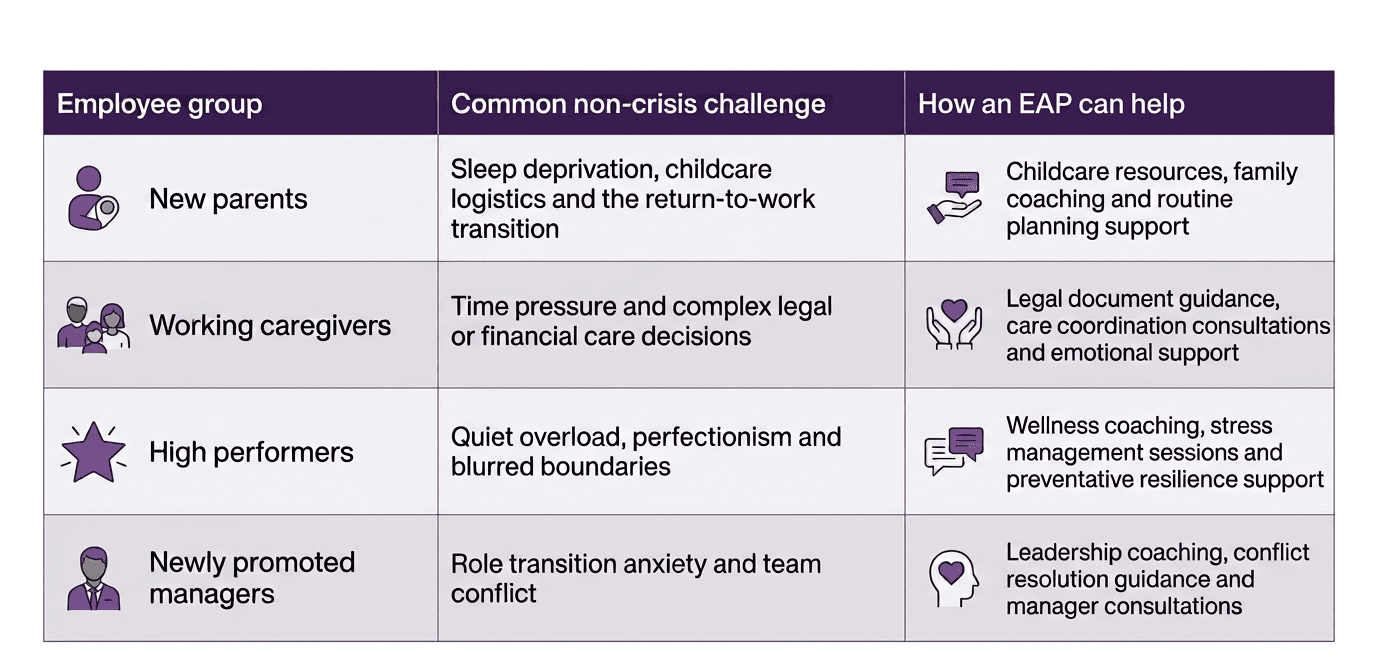
An EAP works across the full wellbeing continuum: from feeling well to struggling to feeling unwell. The biggest opportunity sits in the middle. Reaching people while they're struggling stops everyday stress from becoming a crisis or a long-term absence. Here's what that looks like across common life stages:
How EAPs can help reduce disengagement and quiet quitting
An effective EAP can help employees anticipate challenges before they arise. When challenges do come up, it gives them the tools to act and advocate for themselves in the moment. When an unexpected incident or traumatic event happens, EAP support helps employees manage the immediate impact, respond effectively and move toward recovery.
A senior employee, for example, might use their EAP's financial and legal services to plan the steps they'll need to take before retiring. As the transition begins, they might speak with a mental health coach for support in making big decisions. Once they've retired, their EAP can offer the education and documentation they need to adapt to life after work. And throughout this journey, their EAP is there to support them if a crisis does arise.
Access to flexible and personalised support lets employees get the care they need and feel cared for by their employer. That feeling of care can reduce disengagement and quiet quitting, a phenomenon where performance suffers due to burnout and other stressors.
“Taking care of ourselves is a learned skill, one that we all need support and practice to get good at,” said Dr. Chow. “With an EAP, employees can build that skill with the support of experts to be prepared for anything, so they can bounce back faster and stay well longer.”
Increase EAP use through communication
Any member of a people team can tell you this from experience: employees can't and won't use a resource they don't know about. According to the TELUS Mental Health Index, 31 per cent of employees in the UK aren't sure if their employer offers an EAP (September 2025).
Awareness gaps aren't unique to the UK either. SHRM research found that even among U.S. employees who know they have mental health benefits, only 53 per cent know how to access them, including who to contact by phone, email, or internal support channel.
EAPs aren't as instantly recognisable to the average employee as a health insurance plan. If employees aren't sure what an employee assistance programme is, that set of words could mean anything.
Leadership needs to communicate what these resources mean in concrete terms and in a variety of formats and locations. That communication also needs to debunk misconceptions and stigma around who and what these programmes are for. It's one of the most common workplace wellbeing strategy challenges facing UK employers, especially when communication also has to cover crisis response, not just a general wellbeing strategy.
How to find an EAP employees will actually use before a crisis hits
Start with everyday utility. An EAP that leads with financial guidance, legal consultations and lifestyle coaching gives employees reasons to engage long before a crisis. When events occur, employees are more likely to use an EAP if the organization has already identified practical use cases for it. Onboarding documentation with real-world scenarios helps people picture themselves using the service.
Then equip your managers. Managers should know how to assess needs quickly and connect people to the right support after a critical incident. Many UK managers have the intent to help but lack the confidence and cultural permission to suggest support before performance suffers. Simple referral language makes the difference.
Leaders know their people. When they fully understand the scope of an EAP, they become its best advocates, making these programmes an essential resource and a sound business investment.

TELUS Health
Explore our proactive, scalable solutions that can empower your workforce with the resources they need to stay well and engaged.
Learn moreFrequently asked questions
How do we shift employee perception of the EAP from a crisis line to an everyday resource?
Replace annual announcements with year-round communication tied to real moments like tax season, parental leave returns and promotions. Manager storytelling gives people cultural permission to use the employee assistance programme early.
How should we evaluate UK EAP providers?
Look beyond low headline costs and crisis call volumes. A company should ask about support for more people across locations, crisis response capability, business continuity planning, multimodal access (app, phone, video), clinical network depth, manager training and transparent outcome reporting.
Are EAP services confidential for UK employees?
Yes. Individual usage is never shared with employers. Organisations only see aggregated, anonymised trends, in line with UK GDPR and professional counselling standards.