

Key takeaways
- Holistic support matters: A complete culture of wellbeing covers physical, mental, financial and social health.
- Manager training drives trust: Trained managers bridge the gap between executive strategy and daily employee experience, with non-managers reporting poor support 60 per cent more often than managers.
- Data guides strategy: Combining staff surveys with usage metrics helps HR teams build effective, targeted health options.
- Psychological safety is foundational: Creating safe, confidential channels for disclosure can help build trust and improve retention.
- Compliance creates accountability: Aligning company policies with UK Health and Safety Executive guidance helps protect both staff and business performance.
Working wellness means building a workplace culture that supports employees’ physical, mental, financial and social wellbeing through clear strategy, leadership commitment and structures that work. For HR leaders, managers and organizational decision-makers, that goes far beyond mindfulness apps or gym passes: it includes manager training, psychological safety, targeted wellbeing programs, health and safety compliance and using data to measure adoption and improve results.
Done well, working wellness strengthens productivity, retention and day-to-day performance; done badly, it shows up in absence, turnover and higher costs at a time when workplace stress is rising. Here's how to build a culture of wellbeing that helps everyone succeed by making wellbeing a core company value and backing it with practical systems that last.
Research proves it repeatedly: organisations succeed when their workers are happy and healthy. According to Deloitte, poor mental health costs UK employers up to £51 billion each year due to absence, presenteeism and staff turnover. People showing up and feeling supported directly affects your bottom line.
Beyond financial costs, employers also have a legal duty to manage workplace stress and psychological risks under Health and Safety Executive guidelines (HSE). With rising cost-of-living concerns affecting your workforce both inside and outside work, supporting comprehensive wellbeing isn't optional—it's essential.
But it’s not enough to simply “promote a culture of wellness” in your workplace. Actually building a psychologically safe environment that allows employees to thrive holistically requires an organisation-wide strategy that everyone, from the C-suite down, can enthusiastically embrace and take part in, as well as handpicked programmes that serve the unique needs of the people who make up your workforce.
Through infrastructure, programming tailored to your organisation, and strong communication that makes sure that programming reaches its intended audience, you can build a healthier, happier culture of wellbeing — not just wellness — among your employees.
Understanding wellbeing versus physical health in workplace wellness
Many organisations focus only on physical fitness when planning staff perks. To raise overall workplace morale, HR leaders need to move beyond old ideas about wellness and focus on employees’ more holistic wellbeing.
Physical fitness is only one piece. For example, the TELUS Mental Health Index (MHI) shows financial concerns are the overwhelming source of personal stress among employees in the UK (March 2025). Complete wellbeing covers four pillars:
- Physical health: Exercise, nutrition and sleep quality.
- Mental health: Managing stress, anxiety and emotional resilience.
- Financial wellbeing: Emergency savings, debt management and financial security.
- Social connection: Relationships, community and feeling part of a team.
The McKinsey Health Institute estimates that investing in complete employee health could generate significant global economic value. The impacts of this value include reduced attrition, absenteeism and presenteeism, as well as improved employee productivity, recruitment and retention.
Setting up strong organisational structures
Before you can build a culture of wellbeing in the workplace, you need the right company infrastructure for workplace wellbeing. Health support should connect to everyday business decisions, not exist as an isolated perk. There are three core areas to establish.
Governance and safety
Ensure your health policies follow UK legal standards. The HSE offers clear guidelines on managing stress and psychological risks at work. Review your workplace hazards regularly, document your processes and ensure leadership takes these duties seriously. Consider adopting the Thriving at Work standards alongside HSE guidance to help strengthen your approach.
Psychological safety and disclosure channels
Create safe, confidential spaces for employees to discuss mental health concerns without fear of stigma or career impact. These structures should include anonymous feedback systems for raising wellbeing concerns, confidential access to professional support services, clear anti-stigma policies protecting employee privacy, and manager training on how to handle sensitive disclosures appropriately
Leadership training and official commitments
According to the MHI, people leaders around the world wouldn’t know what to do to support an employee dealing with a mental health issue, and many of them say their organisations don’t offer training on how to handle these issues. Designate experts on your team — people with specific accreditations in mental health and other aspects of wellbeing — to work in tandem with learning and enablement specialists to help you design training programmes for your people leaders. This can help ensure sensitivity and a culture of wellbeing are baked into management styles across the company, while reinforcing the importance of visible backing from senior leaders.
Gathering baseline data to support mental health in the workplace
Before creating new health options, it’s important to collect clear information about your staff. Combining workforce data with brief surveys and employee feedback can help you uncover what your team actually needs. You can measure current state and track progress against defined objectives by monitoring both qualitative and quantitative metrics.
To gather qualitative details, use employee wellbeing surveys to:
- Gauge feelings on workload, stress and manager support
- Ask specifically about confidence in disclosing mental health concerns to managers
- Assess perceived psychological safety across departments
- Gather feedback on which support resources people actually use
While quantitative metrics can include:
- Tracking short-term absence and patterns
- Monitoring staff turnover rates and exit interview feedback
- Measuring adoption of wellbeing programmes
- Reviewing productivity metrics before and after support rollout
- Capturing the manager versus non-manager support gap
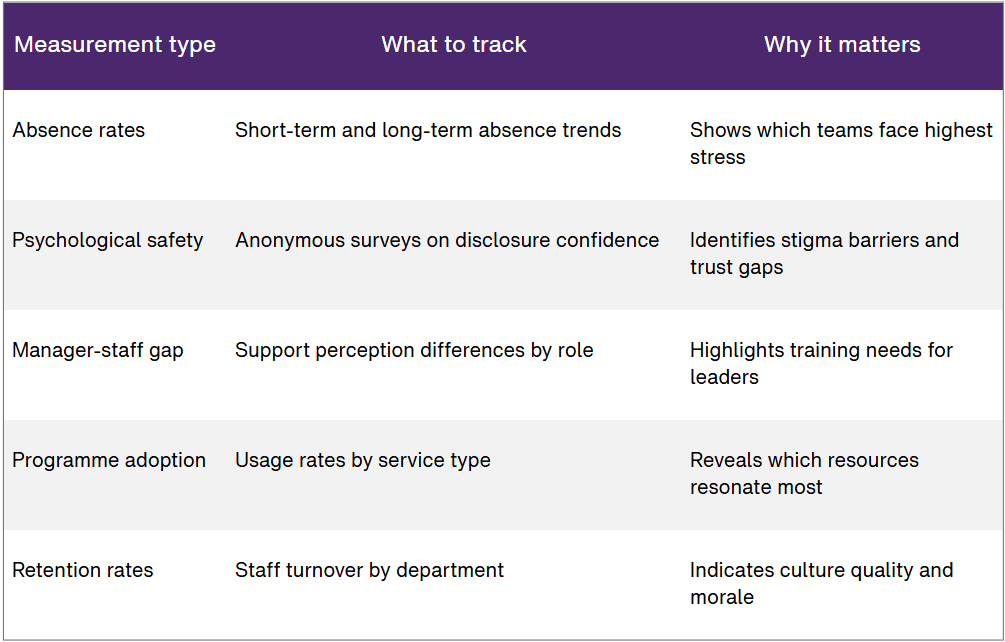
Keep in mind that quantitative metrics alone can’t always show the full outcomes of the broader programme’s success. Morale, recruitment success, retention rates, employee satisfaction and engagement levels — qualitative measures that prioritise value on investment (VOI) over return on investment (ROI) — can be directly connected back to productivity and overall success, too.
Reviewing these metrics regularly can help you adjust programmes before small issues become big problems.
Training managers to help improve trust in the workplace and close support gaps
A major gap often exists between how managers and staff view workplace support. MHI data shows non-managers are more likely than managers to rate employer support for their wellbeing as poor (September 2025). When leaders don't realise their teams are struggling, overall workplace morale can drop quickly.
The workplace can feel full of uncertainty. Managers can help build stability by listening and taking action on employee feedback. Training managers on clear communication can help improve trust in the workplace and supports more engaging management that keeps staff engaged.
Effective manager training should cover:
- How to spot early signs of stress and burnout
- How to start supportive conversations without judgment
- How to direct staff toward professional resources
- How to maintain appropriate boundaries
- How to document concerns and follow-up actions
- How to champion psychological safety in team settings
Training leaders can help organisations apply data about the benefits of employee health and wellbeing solutions; managers can translate statistics into reasons that resonate with their people, because they know them best and help unlock better productivity. Position managers as empathetic connectors between executive strategy and daily staff experience—not as the sole solution to workplace wellbeing.
Designing targeted support programmes for a complete corporate wellbeing plan
Generic programmes rarely work for everyone since different demographic groups face different challenges.
This is where the information you gathered at the outset will come into play, helping you make targeted programming choices based on who you have working for you and what they need, rather than going with generic options that don’t speak to lived experiences.
A complete corporate wellness plan might pair weekly 30-minute mindfulness sessions with workshops that include stress reduction techniques, with clear objectives for participation, stress management and uptake across teams. The “targeted” part is key to how employees perceive, and thus engage with, wellbeing programmes, especially when support reflects different lifestyle needs and encourages lasting change rather than assuming quick lifestyle changes.
Organisations should build a bespoke set of offerings that tailor to varied needs. For instance, you may want both a specialised programme to support the heart health of older employees and a more flexible programme like a wellbeing stipend that appeals to younger workers. Consulting with internal employee resource groups and conducting focus groups can help you design perks that people actually use.
Measuring staff adoption and employee health over time
A wellbeing strategy fails if workers don't use the resources provided. Tracking adoption rates over time can help you see which services offer the most value to your team, along with ROI and business outcomes.
Monitor both quantitative and qualitative adoption metrics:
- Number of staff accessing each service type
- Repeat usage rates (showing genuine value)
- Time-to-first-use after programme launch
- Retention rates and turnover reduction
- Psychological safety score improvements
- Feedback quality from users
According to Deloitte's 2024 Mental Health Report, workplace mental health and wellbeing initiatives can yield £4.70 for every £1 invested, driven by improved productivity, reduced absenteeism and better retention.
When organisations get this balance right, daily productivity can improve. Employees who feel supported spend less time worrying about unresolved personal issues and more time focused on their goals. Over time, that support can also contribute to lower healthcare costs and less turnover, which is a proven reason to keep monitoring adoption and value.
Making wellbeing a core company value
Subsidised gym memberships alone can’t fix companies or businesses with bad management or unmanageable workloads. Promoting a culture of wellbeing in the workplace requires weaving health into your core company values.
Wellbeing should be baked in:
- Performance review criteria and promotion decisions
- Team goals and project planning
- Daily workload expectations and realistic deadlines
- How leaders model healthy working habits
- How conflicts are resolved
- How flexible working is genuinely supported
When you start with healthy working norms and reward behaviours that support wellbeing, it’ll be hard to miss the changes that ripple through your organisation. A truly healthy culture of wellbeing isn’t hard to see — if your strategy is successful, you’ll notice the difference in happy and healthy employees and stronger overall well being, even without data.

The people equation: How human wellbeing can multiply business results
Learn why traditional approaches to employee wellbeing are evolving, and how connecting people with care proactively can help to drive measurable results.
Download the eBookFrequently asked questions
What is a culture of wellbeing in the workplace?
A culture of wellbeing in the workplace means an organisation actively supports the physical, mental, financial and social health of its workers through daily policies, management habits and formal benefit options. It goes beyond one-off perks to embed health into how the organisation operates.
How does mental health in the workplace affect business results?
Poor mental health leads to higher absence rates, lower daily focus and increased staff turnover. According to research, workers with high mental health risk lose up to 66.5 workdays per year in productivity. Supporting mental health can help reduce these costs, improve team performance and help organisations meet legal duties under HSE guidelines.
How can managers help improve trust in the workplace?
Managers can help improve trust by holding regular one-to-one check-ins, monitoring workloads fairly, keeping communication open and directing workers to helpful health resources when needed. Training ensures managers understand their role as connectors rather than counsellors.
What are the biggest threats to employee wellbeing in modern workplaces?
According to the 2025 TELUS Mental Health Barometer, anxiety, isolation and financial stress are persistent challenges. Workplace pressure, lack of career development and feeling undervalued also significantly affect employee wellbeing.
How do we support female employees' wellbeing in the workplace?
Female employees have lower mental health scores than male colleagues. Organisations can help support them through targeted mental health resources, addressing specific workplace stressors, creating psychological safety for disclosure, and ensuring fair workload distribution and career advancement opportunities.