
Key takeaways
- Global wellbeing strategies work best with local implementation. A centralised wellbeing strategy is most effective when local HR teams adapt communications and delivery to reflect the unique needs of their workforce.
- Employee needs vary across markets. Cultural differences, industry dynamics and local workforce priorities all influence how employees experience and engage with wellbeing support.
- Continuous feedback drives continuous improvement. By combining workforce data, employee feedback and local insights, organisations can keep their wellbeing strategies relevant as employee needs evolve.
- Integration strengthens global wellbeing delivery. Bringing wellbeing touchpoints together gives local HR teams the insights and flexibility needed to create personalised employee experiences.
Today’s organisations are adapting to the idea that employee wellbeing can’t be approached with a one-size-fits-all mindset. While the principles of a strong wellbeing strategy may be universal, the needs of employees are shaped by a variety of factors, including the industries they work in, the cultures they belong to and the realities they experience every single day.
For multinational corporations, this creates a unique strategic challenge:
How do you develop a globally consistent wellbeing strategy while ensuring it remains relevant to employees across different cultures and communities?
The answer lies in combining global strategic direction with local implementation. This approach helps organisations create wellbeing strategies that are both consistent in purpose and meaningful in practice, enabling employees to access the right support, in the right way, wherever they are.
Here’s what organisations should know about implementing a global wellbeing strategy across international workforces, and why empowering local HR teams is the key to its success.
The best wellbeing strategies leave room for local decision-making
The real challenge when building a global wellbeing strategy is to ensure it remains relevant for employees working across different countries and different business environments. “We want to have some level of consistency and support on the global level,” explains Meqele Bleasdille, Strategy, insights & transformation consultant at TELUS Health. “At the same time, it’s important to recognise and understand that one size certainly doesn’t fit all.”
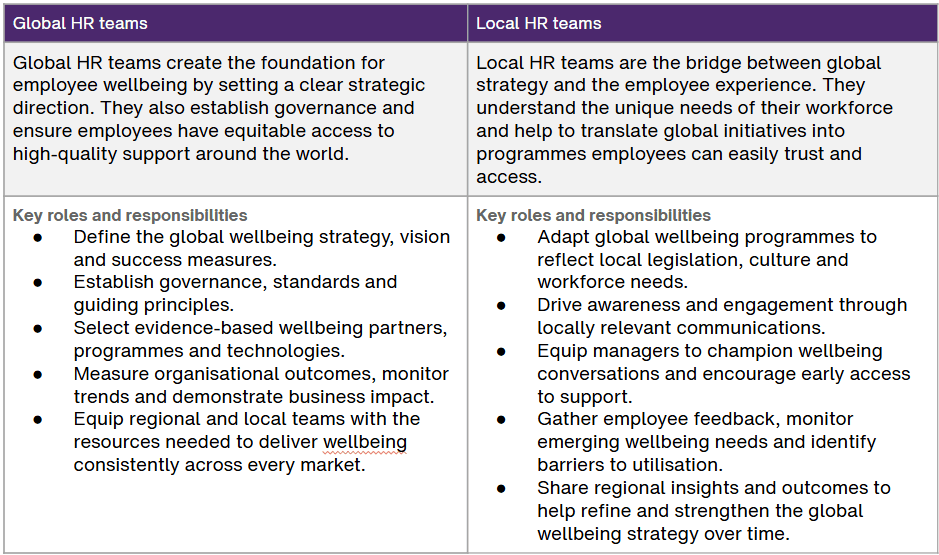
For multinational corporations, balancing global consistency with local relevance comes down to clear ownership. Global HR teams provide strategic direction and evidence-based wellbeing frameworks that help to maintain a level of consistency across the organisation. Meanwhile, local HR teams bring this strategy to life by communicating wellbeing support in ways that reflect the unique needs of regional workforces.
Together, these complementary roles help to transform a global wellbeing strategy into meaningful employee experiences across every market an organisation operates in.
Why localised messaging is the key to wellbeing engagement
Creating a globally consistent wellbeing strategy is only a part of the equation. Organisations also need to communicate wellbeing in ways that reflect the unique priorities of each employee.
This is important because, according to data from the Chartered Institute of Personnel and Development (CIPD), investing in employee wellbeing creates opportunities for individuals and for the vast majority of organisations:
- 54 per cent report the chance to improve people’s health and wellbeing.
- 39 per cent report higher employee engagement and less sickness-related absences.
- 38 per cent report enhanced employee productivity.
Despite this data, many employees remain unaware of what support is available to them, meaning organisations may not be realising the full value of their wellbeing investments.
In markets like the United Kingdom — where nearly 2.8 million people remain economically inactive due to ill health, and where six in ten employers report persistent levels of health-related exits from work — local HR teams should aim to raise awareness of available benefits and communicate the full scope of what’s on offer.
This includes solutions like an employee assistance programme (EAP), which gives employees access to things like financial wellbeing support and preventative mental health services.
Doing this will help to improve wellbeing engagement and, in turn, help organisations maximise their investment in employee benefits by encouraging earlier access to support.
“You can have all the best resources in the world, you could have all the best intentions in the world, but if you have that and you don't reinforce it in a certain way with key messages, it ends up losing some of its value.”
- Paula Allen, Global leader, Research and Insights at TELUS Health
The secret to a successful wellbeing strategy? Continuous feedback
A successful global wellbeing strategy is anything but static, and organisations are on different levels in terms of their maturity with respect to health and wellbeing. “That’s not bad or good,” explains Paula. “You accept where you are and then move on from there.”
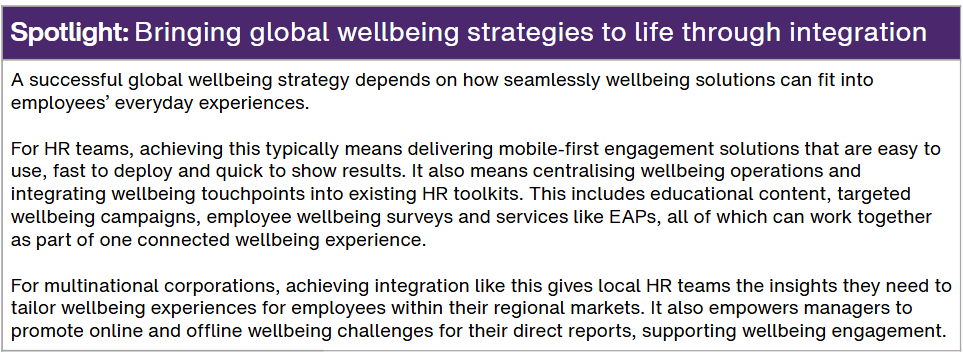
Continuous feedback enables organisations to understand where they are today and identify the next opportunity to strengthen how wellbeing is delivered. This means evolving through an ongoing cycle of listening, measurement and localised feedback, supported by regular employee wellbeing surveys. By actively seeking out (and responding to) these inputs, multinational corporations can continuously refine how wellbeing is delivered without compromising the consistency of their global strategy.
A great way to achieve this is by benchmarking and analysing mental health data. In the United Kingdom, for example, 40 per cent of employees rate employer support for their mental wellbeing as very good or excellent (MHI, Q4 2025). In South Korea, only 20 per cent of employees feel this way (MHI, Q4 2025).
Regional leadership teams in South Korea, then, can leverage this data to run targeted campaigns that increase awareness of available mental health support. Importantly, if similar trends emerge elsewhere, global HR teams can build on those lessons and evolve the broader wellbeing strategy to reflect changing employee priorities across the organisation.
By combining workforce insights with ongoing measurement and feedback like this, multinational corporations can continuously make informed decisions that can help keep their wellbeing strategies relevant and aligned with the needs of their people.
The best global strategies empower local action
The most effective global wellbeing strategies succeed because they empower local HR teams to translate a shared global strategy into experiences that reflect the real cultures, real priorities and real realities of the people they support.
As organisations continue to grow across countries, cultures and different ways of working, this balance between global consistency and local relevance will become increasingly important. And while global HR teams provide strategic direction, it’s the local HR teams that ensure wellbeing is experienced in ways that resonate most with each employee. As Paula Allen sums up:
“It doesn’t matter where your organisation is today. What’s important is doing the best you can where you are and continuing to move to the next level.”
The people equation: How human wellbeing can multiply business results.
To discover how leading organisations are using wellbeing to drive stronger business outcomes, explore our eBook.
Download eBookFrequently asked questions
Why should global wellbeing strategies be implemented locally?
Global wellbeing strategies provide a consistent vision and framework for employee support across an organisation. Local implementation ensures those strategies are communicated and delivered in ways that reflect the unique cultures and day-to-day realities of different employee populations. This helps drive greater awareness, engagement and, ultimately, impact.
What is the role of local HR teams in a global wellbeing strategy?
Local HR teams play a vital role in bringing global wellbeing strategies to life. They adapt communications and enable managers, for example. They also gather employee feedback and deliver wellbeing programmes in ways that reflect workforce priorities and operational realities, ensuring employees experience support that feels both relevant and meaningful.
How can organisations balance global consistency with local flexibility?
Organisations should keep their wellbeing vision, principles and success measures consistent while allowing local teams to tailor delivery, communications and employee engagement.
How can HR leaders continuously improve global wellbeing strategies?
HR leaders can continuously improve global wellbeing strategies by combining workforce data, ongoing employee feedback and localised insights to understand what’s working and where new needs are emerging. This allows organisations to refine how wellbeing is communicated and delivered while remaining aligned to a shared global strategy.
Does local implementation mean creating different wellbeing strategies for each country?
No, it doesn’t. The goal is to maintain one globally aligned wellbeing strategy while giving local HR teams the flexibility to adapt how it’s communicated, delivered and activated. This helps organisations create equitable employee experiences that reflect localised needs without compromising an overall strategy.

Jenna Avella
Copywriter & Senior Marketing Manager at TELUS Health
About the author
Jenna Avella is a Senior Marketing Manager at TELUS Health, specializing in data-driven health and wellness communications designed to help empower organizations and their workforce. With over a decade of professional editorial experience across high-growth health, lifestyle, culture and tech, she brings deep expertise in converting complex health concepts into actionable workplace solutions—from employee assistance programs (EAP) to total wellbeing strategies. Jenna is a graduate from McMaster University and has established a robust track record writing authority-building content for industry-leading health platforms. Her writing focuses on employee wellbeing and mental health and organizational wellness, driving thought leadership across TELUS Health's resource ecosystem.