
Key takeaways
- An employee assistance program (EAP) is an excellent foundation. While EAPs provide valuable short-term support, some behavioral health conditions may require more coordinated and ongoing care.
- Integrated behavioral care helps to reduce barriers to treatment. Dedicated care coordinators, specialized healthcare provider networks and seamless referrals can make it easier for employees to access ongoing behavioral health support as their needs evolve.
- Continuity of care benefits employees and employers alike. Helping employees transition into the right level of care can help improve productivity, reduce absenteeism, strengthen retention and support better long-term health outcomes.
- A connected behavioral health strategy can create greater value from existing benefits. By integrating EAP services with broader behavioral health support, employers can improve the employee wellbeing experience while making better use of their benefits investments.
It’s well established that EAPs play an essential role in supporting employee mental health. In fact, workers with access to an employer-provided EAP have a mental health score that is higher than the national average and more than one point higher than workers without access to one (TELUS Mental Health Index [MHI], Q3 2025).
That said, not every mental health challenge can be (or should be) resolved with targeted and short-term support. According to the Q1 2026 MHI:
- At least one in five workers in the US report unmet needs related to mental or physical wellbeing support.
- Workers who want better mental health support have an MHI score 17 points lower compared to those who don’t need additional support.
- These employees lose 41.7 days per year in productivity due to a lack of mental health support. This is 22 more days per year than workers who don’t require additional support.
How, then, can HR and benefits leaders better support employees whose behavioral health needs extend beyond the scope of an EAP?
The answer lies in developing an integrated behavioral health care model.
In this article, we explore how pairing a trusted EAP with Integrated Behavioral Care helps employers bridge the gap between short-term support and long-term care management, and why doing so is good for business.
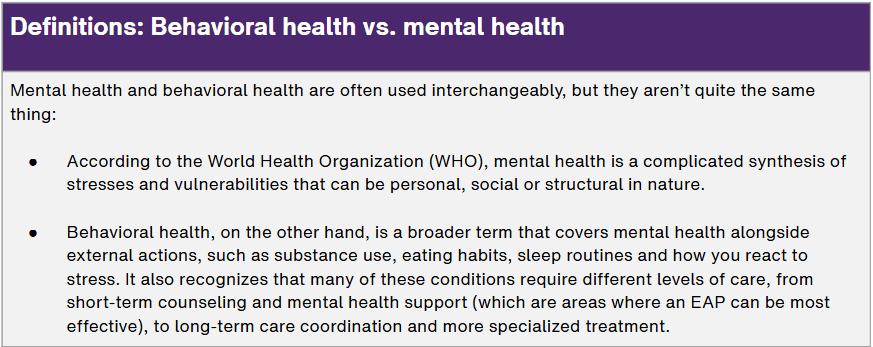
Why do some employees need more than an EAP?
For someone experiencing a short-term life event, an EAP may provide all the support required. As the US Office of Personnel Management explains, an EAP can help employees navigate immediate behavioral health challenges through confidential, free and short-term support.
But, as recent data from the Substance Abuse and Mental Health Services Administration (SAMHSA) suggests, approximately 62 million adults in the US have experienced a mental illness and nearly half of them did not receive treatment for it.
In most cases, behavioral health conditions seldom follow a straightforward path, and the level of support an employee benefits from may vary depending on their unique circumstances. For example:
- Chronic anxiety or depression may benefit from ongoing psychotherapy, medication management and regular clinical reviews.
- Substance use disorders may require medication-assisted treatment, recovery coaching and relapse prevention planning.
- Autism spectrum disorder may involve comprehensive diagnostic assessments, family support and workplace accommodation planning.
- Complex trauma may respond best to specialized therapies such as eye movement desensitization and reprocessing (EMDR) or cognitive processing therapy delivered over an extended period.
An EAP can be an important first step to addressing these conditions, but without a clear path into ongoing care, how exactly can employers continue to help support employees across the entire care continuum?
What integrated behavioral care adds to the continuum of support
If continuity of care is the challenge, integrative behavioral care is designed to help solve it. It does this by building on the strong foundation an EAP already provides, helping employees to move seamlessly into the next stage of care when appropriate.
Here’s how an integrated behavioral care model can help to support employees across the entire care continuum.
It helps to connect employees with the right support, at the right time
Behavioral health services help to connect employees with dedicated care coordinators who assess their needs, coordinate referrals and guide them through the next stage of their care journey.
TELUS Health’s integrated behavioral care solution, for example, does this by relying on a preferred provider organization (PPO) model. This model encompasses a nationwide network of more than 75,000 vetted behavioral health providers including psychiatrists, substance use specialists, autism assessment services and more. This gives employees:
- Greater choice when finding the right provider based on their unique needs.
- Continuous support throughout their care journey as they move between different services and providers, helping to reduce disruptions in treatment.
- Flexible and accessible coverage for ongoing care thanks to a fee-for-service model that offers greater flexibility as employees’ behavioral health needs evolve.
It helps to make ongoing behavioral health care easier to access
According to the Q1 2026 MHI, 44 percent of workers in the US cite cost or affordability as the biggest barrier to receiving mental health support. Many other employees point to long wait times, uncertainty about where to find care or not knowing which type of support is right for them.
Integrated behavioral care helps to remove many of these barriers by taking the guesswork out of finding ongoing support after EAP benefits have run their course. So, instead of expecting employees to navigate the healthcare system on their own, integrated models provide employees with care coordinators who can help them (and, when needed, their families) maximize their available benefits programs and find local and specialized healthcare providers.
What does behavioral health support look like across the full care continuum?
The following examples illustrate how an EAP and integrated behavioral care models can work together to support employees with different behavioral health needs.
Scenario 1: When an EAP is exactly what’s needed
Employee: Sarah, marketing manager
Following a recent divorce, Sarah begins experiencing anxiety, difficulty sleeping and trouble concentrating at work. Recognizing she needs support, she contacts her employer’s EAP.
That same evening, Sarah speaks with a clinician who helps de-escalate her immediate concerns and provides practical coping strategies. Over the following eight weeks, she attends six counseling sessions focused on managing anxiety and adjusting to a significant life transition.
By the end of her treatment, Sarah’s symptoms have improved, she’s sleeping better and has regained confidence both at work and at home. Because her challenges were situational rather than chronic, she doesn’t require additional behavioral health services.

Scenario 2: When short-term support becomes long-term care
Employee: Marcus, software engineer
Marcus contacts his employer’s EAP after experiencing several panic attacks that begin affecting his work and home life. During his first few counseling sessions, it becomes clear that his symptoms extend beyond situational stress, so his counselor connects him with an integrated behavioral care coordinator.
Together, they develop a personalized care plan that includes ongoing therapy with an anxiety specialist, a psychiatric evaluation and additional support resources. Rather than navigating multiple providers on his own, Marcus has a single point of contact coordinating his care.
Over the following months, his panic attacks become less frequent, his confidence returns and he’s able to successfully manage his condition over the long term.

Scenario 3: When a family member needs specialized support
Family member: Jin’s wife, Alice
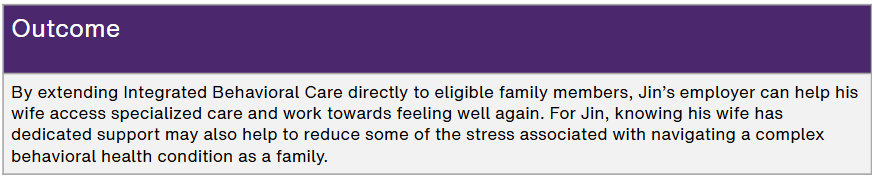
Jin’s wife of nine years, Alice, has been struggling with an eating disorder. As her condition becomes more serious, she and her family realize that she needs more specialized support beyond short-term counseling.
As an eligible family member under Jin’s employer-sponsored behavioral health benefits, Alice can access Integrated Behavioral Care directly. She’s connected with a dedicated care coordinator who helps assess her needs, understand her available benefits and identify appropriate eating disorder specialists within the provider network. As Alice’s needs evolve, the care coordinator helps her navigate different stages of treatment and remains a consistent point of contact throughout her care journey. This provides great continuity for Alice, who is now able to work through this disorder with her family, keeping them updated on what support is available along the way.
The value for employers: How integrated behavioral care models can help to create a wellbeing ROI
The business impact of poor behavioral health is already well documented. In the US alone, it’s estimated that the annual cost of unplanned absences is $600 billion USD, averaging $4,080 per full-time employee.
At the same time, the Q4 2025 MHI found that a quarter of all workers in the US report their mental health is impacting work productivity.
Rather than treating EAPs and other behavioral health services as entirely separate support systems, an integrated model of care connects them into one single and coordinated experience.
This helps employees access the appropriate care they need sooner so they can remain engaged throughout treatment and avoid unnecessary disruptions in their care journey.
For organizations looking to measure workplace mental health ROI, providing integrated care like this may translate into:
- Higher productivity by helping employees address behavioral health challenges before they affect performance.
- Reduced absenteeism through earlier intervention and better continuity of care.
- Lower long-term healthcare costs by reducing the likelihood that untreated conditions escalate into more complex and expensive interventions.
- Stronger employee retention by supporting people through both short-term challenges and long-term behavioral health needs.
- Better value from existing benefits by helping employees understand and use the behavioral health resources already available to them.
The fact of the matter is, supporting behavioral health won’t solve every engagement challenge. But, by helping employees access timely and coordinated care, employers can help to remove barriers to care and ensure people are given the opportunity to perform at their best. In turn, this helps organizations to create lasting value for their workforce.
For example:
- 96%* of members who contact TELUS Health for behavioral health support report they are satisfied with the services offered.
- 98%* is the client retention rate that TELUS Health has maintained since 2020.
Building a more connected behavioral health strategy
Right now, 21 percent of workers in the US experience disabilities, including autism. What’s more, an estimated 46 million adults in the US aged 18 or older experience substance use disorder (SUD), and nearly two-thirds of this population (30.1 million) are employed.
As the prevalence of chronic and complex behavioral health conditions continues to grow, employers may need to think beyond standalone benefits programs and toward a more integrated model of care. This is especially true given that short-term disability claims for mental health are skyrocketing as Bloomberg reports that approximately 67 percent of employers in the US have seen an increase in mental health-related leaves of absence and accommodation requests over the past year alone.
The next step for employers, then, is understanding how well your current benefits are supporting employees across the full care continuum. This includes asking questions like:
- Are there clear pathways from short-term counseling into ongoing treatment?
- Can employees easily access specialized providers?
- Are they receiving the support they need before challenges begin affecting their health, productivity and engagement?
These questions are an important starting point for any organization looking to strengthen its behavioral health strategy. To better understand the behavioral health trends shaping today’s workforce, however, it’s important to stay informed of the latest research.

The people equation: How human wellbeing can multiply business results
To discover how leading organizations are using wellbeing to drive stronger business outcomes, explore our eBook.
Download the eBookFrequently asked questions
How does integrated behavioral care fit into a broader well-being strategy?
Integrated behavioral care is designed to complement and not replace an EAP.
While an EAP provides immediate support during times of need, integrated behavioral care extends that support across the full care continuum by combining behavioral health benefits, care coordination and specialized clinical services into a single experience.
How do you handle conditions outside the scope of care for behavioral health (for example, chronic physical illness)? Do employees need two separate care teams?
Not necessarily. Behavioral and physical health can often influence one another, which is why coordination is such an important part of the employee experience.
Rather than expecting employees to coordinate care themselves, TELUS Health provides designated care coordinators and plan navigators who can help employees and their families source local and customized referrals, as well as provide recommendations on how to maximize benefit plans.
This coordinated approach helps employees access the most appropriate behavioral health resources while working alongside their existing medical benefits.
How can managers identify and refer employees appropriately?
Managers don’t need to diagnose behavioral health conditions. Their role is to recognize when an employee may be struggling and connect them with available resources.
TELUS Health also supports this with supervisory referrals, which assist managers with personal and work-related challenges impacting an employee’s job.
Once an employee is referred, designated care coordinators can step in to help assess their needs, coordinate referrals and connect them with appropriate services.
We're currently self-insured (or fully insured). Will integrated behavioral care work with our current medical plan arrangement?
Integrated behavioral care is designed to connect into existing health plan arrangements rather than replace them.
TELUS Health works with healthcare professionals on a real-time basis and provides comprehensive coordination of all mental health and substance use disorder (MHSA) benefits through its vetted provider network.
For self-insured employers in particular, this helps simplify administration while giving employees access to a nationwide behavioral health network and coordinated care.
How do we measure success for this type of program?
TELUS Health’s integrated behavioral care model is designed to deliver both clinical and business value, and employers should evaluate outcomes such as employee access to care, continuity of care, productivity, absenteeism, healthcare spending and employee satisfaction.
*TELUS Health proprietary data

Jenna Avella
Copywriter & Senior Marketing Manager at TELUS Health
About the author
Jenna Avella is a Senior Marketing Manager at TELUS Health, specializing in data-driven health and wellness communications designed to help empower organizations and their workforce. With over a decade of professional editorial experience across high-growth health, lifestyle, culture and tech, she brings deep expertise in converting complex health concepts into actionable workplace solutions—from employee assistance programs (EAP) to total wellbeing strategies. Jenna is a graduate from McMaster University and has established a robust track record writing authority-building content for industry-leading health platforms. Her writing focuses on employee wellbeing and mental health and organizational wellness, driving thought leadership across TELUS Health's resource ecosystem.