

How children's mental health is driving burnout, presenteeism and anxiety among UK employees
Key findings
- At least one in four working parents say their child's mental health is a direct source of workplace concern. According to Deloitte UK, this specific worry costs UK employers an estimated £8 billion a year.
- One in five children and young people in England now has a probable mental health disorder, a rate that has more than doubled among 17 to 19-year-olds since 2017, according to NHS England Digital.
- 64 per cent of working parents feel supported by their manager, yet 54 per cent of that same group still report anxiety symptoms, a sign that support is reaching people even where it hasn't yet eased what's driving the anxiety.
- Working parents who go to work unwell lose an estimated 32 additional productive days a year. Those whose mental health is actively hurting their output lose another 24 as reported in our latest report, Working Unwell.
Working parents have support and are still struggling
Many HR leaders can point to real investment in supporting working parents: benefits packages, flexible working policies, several forms of mental health provision. On paper, the wellbeing infrastructure exists. TELUS Health's recent report, Working Unwell: The hidden burden of UK working parents and the path to meaningful support, found a paradox running through all of it. In 2026, working parents are experiencing higher burnout, more presenteeism and are less likely to seek help than colleagues without children.
This article looks at why that gap exists. Working parents already have access to support in most organisations. What's often missing is support built around the actual source of the pressure, their children.
"There's a growing gap between the level of need and the availability of timely, specialised support. When families can't access what they need, that pressure ripples into every part of their lives, including work."
Dr. Maria V. Doria, Director of Child & Family Clinical Care, WPO by TELUS Health
The current state of children's mental health in the UK
According to NHS England Digital, one in five children and young people in England aged eight to 25 had a probable mental health disorder in 2023. Among 17 to 19-year-olds specifically, that figure had reached 23.3 per cent, more than double where it stood in 2017. That shift happened fast. The system hasn't scaled to meet it.
More than 320,000 children were still waiting for mental health support after a referral at the end of the 2023-24 school year, according to the Children's Commissioner for England, with many of those waits stretching into months or years. Referrals passed one million the following year. Education, health and care plans in England passed 700,000 in early 2026, up 12.5 per cent in a single year, the largest annual increase since the framework began.
None of this is abstract for a parent living it. Waiting for a diagnosis, working out what support a school can actually offer, or trying to get in front of the right specialist isn't a side project. It runs alongside the job they're paid to do and Dr. Doria sees the effect of that up close in her own clinical work with families.
How children's mental health follows working parents into work
At least one in four working parents say their child's mental health is a direct source of concern that follows them into work. That concern tends to show up in three distinct ways:
- Mental load: the ongoing cognitive weight of tracking a child's diagnosis, appointments and referral pathways, made heavier because so much of it can only happen during standard working hours.
- Emotional labour: the background weight of not knowing whether a child is getting the right support, even on a day when nothing urgent happens.
- Practical disruption: school calls, missed appointments and a child's crisis landing in the middle of a deadline.
Deloitte UK estimates this costs UK employers around £8 billion a year in lost productivity, absenteeism and reduced engagement. Behind that figure is something much more immediate for the parents living it: an ordinary working day spent split between two jobs at once.
Parental burnout and presenteeism
Mental Health Index Data for Working Parents in the UK shows that 63 per cent go to work unwell at least once a week. Behind that statistic is an ordinary Tuesday for a lot of parents: sitting in a meeting while part of their attention stays on an unanswered school email, an appointment they still need to book or whether their child is actually okay right now.
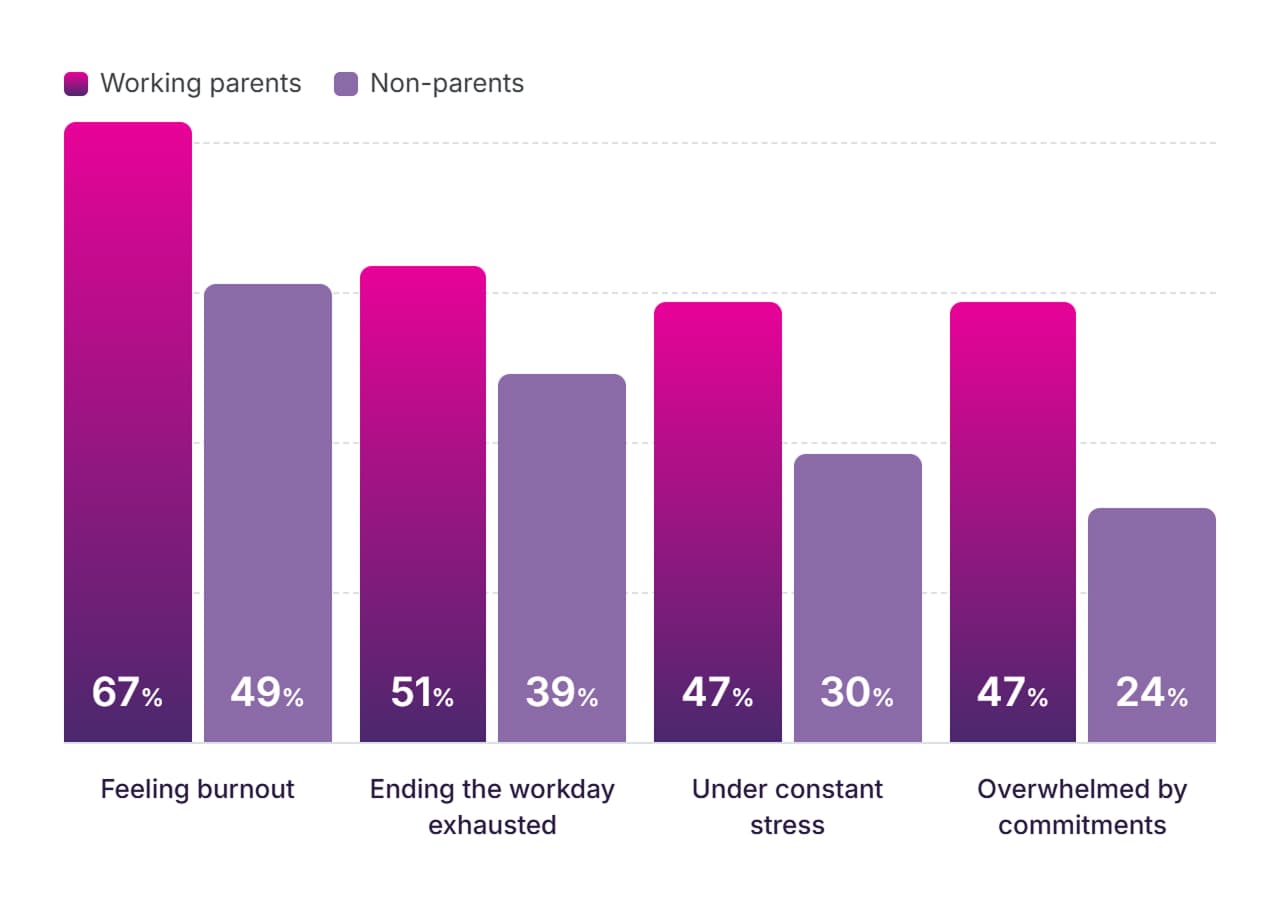
It's a kind of strain that doesn't show up in sickness absence figures. Parents who go to work unwell lose an estimated 32 additional days of productive output a year, and parents whose mental health is actively hurting their productivity lose another 24 on top of that.
Multiplied across even a modest share of a workplace, that's a scale that's hard to ignore.
The stress multiplier behind parental burnout
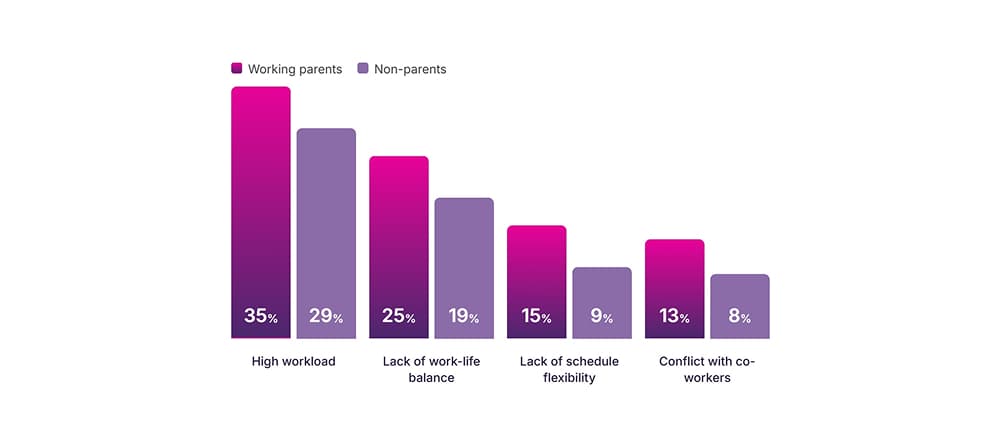
In the Working Unwell 2025/26 report, high workload is the most-cited source of stress for working parents. Workload doesn't sit in isolation though. It stacks on top of managing a child's healthcare, financial pressure and the low-grade anxiety that comes with any gap in a child's care.
This is less a resilience problem than a design one. Most workplaces were built as though caregiving simply didn't exist alongside a job. When it does, employees are left to absorb that mismatch on their own.
The anxiety paradox among working parents
In the Working Unwell 2025/26 report, 53 per cent of working parents describe their employer as family-friendly. Within that same group, 35 per cent still report significant anxiety symptoms. Among the 64 per cent who feel supported by their manager specifically, 54 per cent still report anxiety.
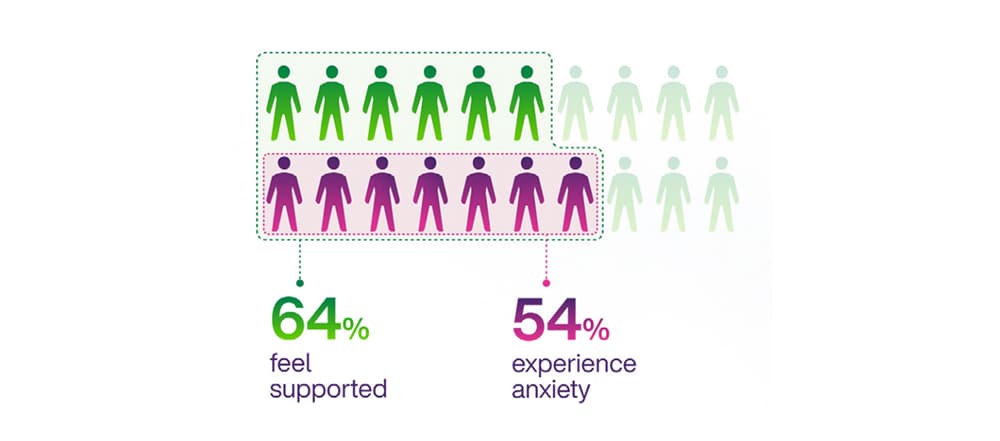
That gap points to something specific. The support on offer isn't addressing what's actually causing the strain. A manager can be genuinely empathetic and still not be able to speed up an NHS referral, shorten a diagnostic wait or make a school meeting happen without pulling a parent out of their working day. They can listen. They can offer flexibility. What they can't do is close a gap that's structural.
Why manager support has a limit
A manager who models openness, recognises early signs of distress and responds with real flexibility creates the conditions for people to actually ask for help. Dr. Doria's own research backs that up directly:
"The quality of the manager-employee relationship is one of the strongest predictors of engagement and retention. Employees are more likely to remain committed and perform at their best when they feel trusted, valued and supported by their leaders."
That's worth investing in. It's also where the ceiling shows up. Picture a parent whose child is struggling. They need an afternoon a week for appointments, or the flexibility to take a school call mid-morning. A supportive manager says yes. But if that parent's workload assumes no other responsibilities, saying yes to the appointment just means falling behind elsewhere. Manager goodwill can't fix that on its own. The response has to go beyond one person.
Support at the manager level doesn't reach workload design, team structure, financial pressure or the specialist access a family actually needs. Among the 21 per cent of parents who don't feel supported by their manager at all, 52 per cent report helplessness, a marker of severe distress. These parents are being heard. What happens after the conversation is where it stalls.
What closing this gap actually requires
Manager empathy is real and worth investing in. However, organisations also need to think about workload design, team capacity or a family's access to specialist care. Closing those structural gaps takes two things working together: team-level structures that don't depend on any one manager, and family-centred support that goes further than most workplace benefits currently reach.
Frequently asked questions
Does a child's mental health really affect a parent's productivity at work?
Yes. At least one in four working parents cite their child's mental health as a direct workplace concern, and according to Deloitte UK, this alone costs UK employers an estimated £8 billion a year in lost productivity and absenteeism.
What is presenteeism, and why does it matter for working parents?
Presenteeism is being physically at work while unable to fully focus, often because of stress at home. It matters because it rarely shows up in absence figures, so organisations tend to miss both the problem and its cost.
How does the state of children's mental health in the UK affect employers?
Rising need and long NHS waiting times mean more parents are managing a child's care during working hours. That pressure shows up as burnout, presenteeism and reduced focus well before it shows up in absence data.
What can employers do if manager support isn't reducing parental anxiety?
Build structures that don't rely on one manager, including shared workload, psychological safety, structured check-ins and genuine flexibility, alongside specialist family support.