
Key takeaways
- Research suggests that low EAP utilization stems from a communication gap. Employees need clear, consistent communication about what services are available, how they work, and why an EAP should be trusted.
- Affordability shapes employee expectations. Workers in the US place greater emphasis on cost, financial accessibility and understanding how an EAP complements their existing healthcare benefits.
- Awareness extends beyond mental health. Many employees remain unaware that EAPs include services like financial counseling, legal guidance and nutritional support. This creates opportunities for stronger communication.
- Targeted messaging improves engagement. Tailoring EAP communication to different employee groups can help more people recognize the value of the support available and feel confident accessing it.
Employee assistance programs (EAPs) are designed to make support easier to access, but availability alone doesn’t always guarantee engagement. Even when an EAP is available, employees may hesitate to use it because they’re unsure how it works, uncertain about what it costs or unconvinced that their information will remain confidential.
While these barriers are shared by employees in both Canada and the United States, they aren’t always driven by the same factors. To better understand them, the TELUS Health Research team partnered with the University of Toronto (UofT) to conduct in-depth interviews with employees across both countries who had access to EAP services but had never used them.
The findings revealed some important differences. Employees in the US, for example, place greater emphasis on financial accessibility and affordability, while employees in Canada are more concerned with cultural competence and representation.
At a time when 67 percent of workers in the US are at high or moderate mental health risk, helping employees feel confident accessing support has never been more important (MHI, Q1 2026). The challenge is that employees don’t always understand what’s available with their EAP, how it works or why they should trust it.
In this article, we explore what the research reveals about workplaces in the US and examine practical ways HR and benefits leaders can better communicate the value of EAPs to help improve utilization and, in turn, employee wellbeing.
Understanding EAP perceptions in the United States
Employees in the US bring a distinct set of expectations to workplace mental health support, shaped in part by the realities of the country’s healthcare system.
Unlike Canada, where publicly funded healthcare provides a baseline level of access, employees in the US rely heavily on private insurance. So much so, in fact, that more than 163 million Americans — or half of the US population — depend solely on employer-sponsored care.

Source: National Library of Medicine
Despite this, many workers don’t fully understand how EAPs fit alongside other healthcare benefits they already have access to. As one survey participant explained, “What falls under EAP services? Because I guess I’m not clear on that aside from mental health and counseling.”
This gap in understanding presents a unique opportunity for employers. By positioning EAPs as immediate, barrier-free support that complements existing healthcare options, HR leaders can help employees feel more confident accessing support when they need it.
The communication gap behind low EAP utilization: What the research reveals
Employees aren’t asking organizations to reinvent their EAP offerings, and research suggests that low utilization stems from a communication gap rather than a service gap. In fact, according to the TELUS Mental Health Index, 63 percent of workers in the US are unsure whether their employer even offers an EAP (MHI, Q4 2025).
Raising awareness, then, is the first step toward increasing utilization. Once employees know an EAP exists, three other factors consistently influence whether they decide to use it.
1. Accessibility and convenience
First and foremost, employees want some reassurances that support is easy to access and, importantly, that it’s worth their time. One participant explained that “I’m not going to want to fill out 10 different forms and then wait for a call.”
Another highlighted the importance of flexibility, stating that “the biggest thing for me would be the convenience factor. Most things happen during the workday and you want it to be confidential so you don’t have to tell people why you need this time off.”
These findings suggest that improving utilization begins with giving employees clear and practical information about their EAP. The easier it is for people to understand what’s covered, how to access support and what to expect, the more confident they’ll feel using services at a time that’s convenient for them.
2. Trust and confidentiality
Beyond affordability and ease of access, employees also want to know that EAP use is completely private. As one participant explained, “I’m not confident about confidentiality. Even if they say it’s private, I worry the employer might find out. That’s why I’d prefer a third-party service.”
This concern can feel even stronger when employees are dealing with work-related stress, large workloads or conflict. Another participant expressed that “if you were to discuss work stress or workload, I don’t think that’s something you would definitely speak to your manager about. Things of that nature, I would feel very uncomfortable about that.”
To build trust in something as sensitive as privacy, it’s important to explain confidentiality in plain language. Employees should understand who provides the service and how an EAP is separated from HR departments or upper management teams. They should also know that only aggregate trends are shared with the employer, and even then, only when volume is sufficient.
Ultimately, employees need constant reminders that the services they have access to are indeed confidential. Communicating this clearly and consistently will help individuals better understand that EAPs are in place for the employee, and that access remains both private and judgment-free.
3. Cultural relevance and representation
Finally, research found that employees are more likely to use EAPs when support feels relevant to their lives, backgrounds and needs. “I always feel like my situation is very unique and it may be very situational, which may not be understood very well by somebody who may not be an immigrant,” one participant explained.
This highlights the importance of localized EAP communication. While many organizations offer a consistent set of EAP services across their global workforce, how these services are communicated should vary depending on the people they’re intended to support. It’s equally important to highlight that EAPs offer a broad range of services beyond traditional counseling, including financial guidance, legal assistance and even personal development resources.
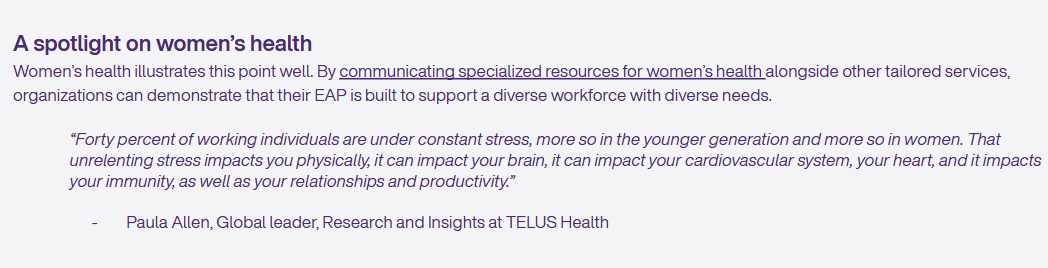
Communicating specialized services more clearly can help employees better understand the full value of their EAP. And rather than promoting an EAP as a single mental health resource, HR leaders should tailor communications to meet the diverse needs of the workplace. This will help to position EAPs as a relevant everyday resource rather than something employees only turn to in a crisis.
The American difference: Why financial accessibility matters most
While many of the barriers to EAP utilization are shared across Canada and the United States, the research conducted by the TELUS Health Research team and the University of Toronto uncovered one important difference about workers in the US: They exclusively view affordability as a prerequisite for EAP engagement, not understanding that an EAP is always free for the worker and their dependents.
This finding underscores why it’s vital to clarify that an EAP doesn’t require payment from the individual using the service. This should be central to how EAPs are positioned and communicated to employees in the US As one participant noted, “If the company paid and I can do it virtually or in-person, that would be amazing. I’ll be all for it.”
Deep dive: The link between financial wellbeing and mental health
Financial stress is one of the strongest drivers of poor mental health for workers in the US In fact, workers without emergency savings experience a mental health score 15.7 points lower than average, while workers with emergency savings score 5.2 points higher than average (MHI, Q1 2026).
These statistics reinforce that financial wellbeing is closely tied to overall mental health, and they help to explain why affordability emerged as a defining theme among American survey respondents.
Given that 17 percent of employees in the US want better support with financial resources, education or consultation, it’s important to make financial wellbeing a much more visible part of your EAP communications (MHI, Q1 2026). Don’t assume employees know these services exist. Instead, proactively highlight them, emphasizing that they’re available at no additional cost.
Education influences financial wellbeing
Similar to financial wellbeing, education also plays an important role in overall wellbeing. For example, 56 percent of workers with a postgraduate degree say they find their work fulfilling, compared to 44 percent of those with a college education. What’s more, laborers — whose roles are more likely to have lower formal education requirements than many office-based professions — have a lower mental health score than service industry and office workers.
Tailor EAP communications to these employee groups rather than relying on broad, one-size-fits-all messaging. By making financial wellbeing services more visible to lower-income and less-educated workers, you can help the employees most likely to benefit from an EAP better understand what support is available.
“If you don’t personalize your EAP communication, you can’t engage people in services and you can’t change behaviors, which is what actually leads to better health.”
- Paula Allen, Global leader, Research and Insights at TELUS Health
Turning insights into action: Practical next steps for HR leaders
Here are three ways you can begin strengthening EAP communications and help more employees understand, trust and use the support available to them.
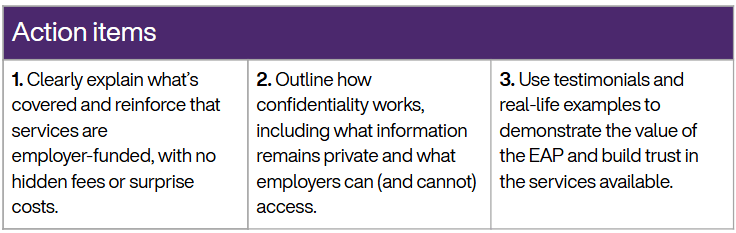
1. Redesign EAP messaging and communicate in the American context
Employees don’t fully understand what’s included in their EAP or whether they’ll have to pay for services. Reducing uncertainty around cost, coverage and privacy can remove some of the biggest barriers to utilization.
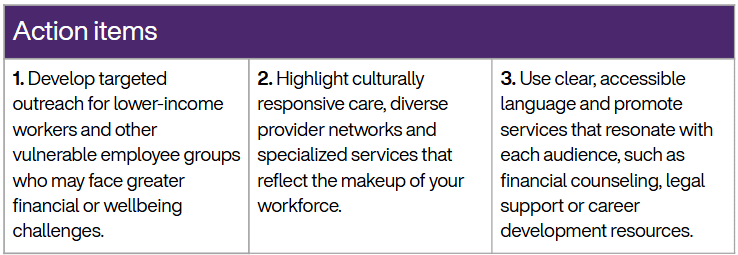
2. Tailor communications to different employee groups
Employees are more likely to engage with an EAP when they can see themselves reflected in the support available. Rather than relying on broad messaging, tailor communications to the needs and experiences of different employee subgroups.
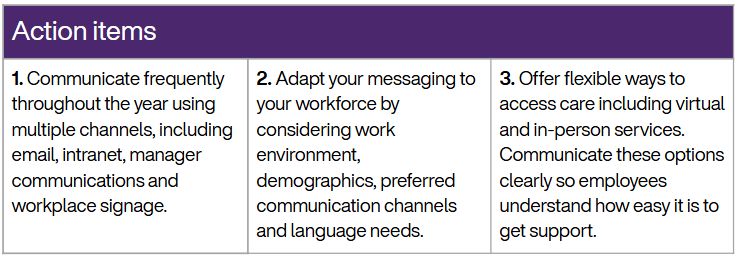
3. Meet employees where they are
An effective EAP communication strategy extends beyond annual benefits enrolment. Ongoing and accessible communication will help to keep services visible and ensure employees know where to turn when they need support.
Better communication can help lead to better EAP utilization
Improving EAP utilization starts with helping employees understand the support already available to them. When organizations communicate EAPs more transparently, they make it easier for everyone to recognize the value of these services and feel confident using them.
By applying insights from TELUS Health’s research, HR and benefits leaders can build relevant, responsive communication strategies that not only increase utilization but also deliver meaningful ROI on investments in employee support.
“One of the skills and one of the investments that needs to happen is communication, because you can have all the best resources in the world, you could have all the best intention in the world, but if you have that and you don't reinforce it in a certain way with simple repetitive messages, it ends up losing some of its value.”
- Paula Allen, Global leader, Research and Insights at TELUS Health
Get the latest and greatest in employee wellbeing research
Receive Mental Health Index reports from TELUS Health and gain access to data-driven insights on employee mental health.
Subscribe todayFrequently asked questions
What are the biggest barriers preventing employees in the US from using their EAP?
Research suggests that many employees are unsure what EAP services are available or are concerned with privacy and confidentiality. They also don’t understand how an EAP adds value alongside other healthcare benefits. This makes clear and concise communication one of the most important drivers of EAP engagement.
What makes expectations of EAPs different for employees in the US?
Workers in the US place greater emphasis on affordability, cost transparency and understanding how EAPs complement their existing healthcare benefits. They may not fully realize that an EAP will not cost them anything.
How can HR leaders improve EAP utilization?
Clear, ongoing communication is essential. Organizations should explain what services are available, address confidentiality concerns, tailor messaging to different employee groups and promote their EAP throughout the year.
Why is financial wellbeing important to EAP engagement?
Communicating financial counseling, budgeting support and other financial wellbeing services can help employees address one of the biggest drivers of mental strain. Many EAPs also offer services that can alleviate other concerns, such as legal guidance and retirement planning.

Jenna Avella
Copywriter & Senior Marketing Manager at TELUS Health
About the author
Jenna Avella is a Senior Marketing Manager at TELUS Health, specializing in data-driven health and wellness communications designed to help empower organizations and their workforce. With over a decade of professional editorial experience across high-growth health, lifestyle, culture and tech, she brings deep expertise in converting complex health concepts into actionable workplace solutions—from employee assistance programs (EAP) to total wellbeing strategies. Jenna is a graduate from McMaster University and has established a robust track record writing authority-building content for industry-leading health platforms. Her writing focuses on employee wellbeing and mental health and organizational wellness, driving thought leadership across TELUS Health's resource ecosystem.